oTAPE 1.0 · open specification · release candidate
Press record.
Mean it.
oTAPE is an open file format for digital cassettes. One .otape file holds a whole tape: two sides of fixed length, each one continuous recording, plus the label, the J-card and the record tabs. It's self-contained and works offline.
Extension
.otape
Container
ZIP + JSON
License
CC BY 4.0
Shell Ferro Black
Drawn in your browser from a few lines of appearance JSON. The reels follow the spec's tape-pack model.
01 The idea
The slow way,
on purpose.
Making a mixtape used to take an evening. You picked every song, sat through the recording and wrote the titles by hand. oTAPE is a file format that keeps those constraints. It isn't a new codec or a music player: it describes a whole cassette.
01
A cassette,
not a playlist.
Each side is one continuous take. The silence between songs, a spoken intro, the clunk of the pause button: it's all part of the recording. Track markers can name the songs without splitting the side.
02
It behaves
like tape.
A fixed length, two sides on one tape, and a position you reach by winding, not jumping. Play side A to the end, flip the cassette, and you're at the start of side B.
03
The file is
the object.
Audio, label, J-card, booklet and history all live inside one .otape. It never links back to the MP3s it was recorded from, or to anything online.
04
Listening
is read-only.
Playing a tape never changes the file. The player remembers your place separately, the way a real tape stays wound where you left it.
05
Open and
simple.
A ZIP archive, one JSON manifest, AAC audio, PNG or JPEG artwork. Every part is a standard format you can open with existing tools.
06
Each tape has
its own look.
Supply artwork at exact physical proportions, or describe the shell and label in a few lines of JSON that any player can draw.
02 Try it
Put a tape
in the deck.
This is the oTAPE Web Deck: about 1,200 lines of plain JavaScript, no libraries. It comes loaded with Gitsem, a C10 single that Mirat Can Bayrak wrote at 24 and recorded again at 42, and plays any .otape you drop here. Files stay in your browser and are never uploaded.
Gitsem by Mirat Can Bayrak, licensed under CC BY 4.0. Source.
_o_TAPE Web cassette deck OT-W RECTAPE RUN
Insert cassette
Download Open .otape…
or drop a file anywhere on the deck
Counter**---**
SideAB
Time**-:--**
Remain**-:--**
Tape**---**
NO CASSETTE
Now—
Tape mapclick to wind
0:00
Output
Space play / stop ←→ rewind / fast forward F flip E eject
03 Tape sound
Same tape.
Another machine.
A cassette never sounded the same in two players. oTAPE players can now play a tape the way a machine of the era would have: a studio deck, a car stereo, a portable stereo that has seen better days. The sound changes on its way to your speakers. The file stays exactly as it was recorded.
_o_TAPE Tape sound selector TS-6
−1 % 0 +1 %
Speed**+0.00 %**
Pitch over the last five seconds
How it's done
- WobbleNo motor turns perfectly evenly. A slow drift in speed bends the pitch (wow), a fast shiver roughens it (flutter). The player reads the music a hair early or late, moment by moment, so the pitch wanders just as much as it did on that machine.
- HissEvery tape has its own bed of noise. It runs while the tape runs, between songs and over blank tape too, and stops the moment you press stop.
- WarmthRecord a tape hot and it rounds off the peaks, the treble first. That gentle squeeze is a big part of why cassettes sound warm.
- WearOld tape loses its top end, drops out for a split second where the coating has worn thin, and a head knocked out of line smears the stereo picture.
Nothing is baked in. The machine is applied while you listen. Your .otape file isn't touched, recordings stay clean, and you can switch machines in the middle of a song.
Machines are files. Each one is a small open preset, an .otsound file, written in real-world units: percent of speed, decibels, hertz. So a portable stereo sounds the same in every oTAPE player. Six come built in; make your own and share it.
04 Inside the file
Unzip a
cassette.
An .otape file is an ordinary ZIP archive with a fixed layout: a mimetype entry first, so tools can identify the file without unzipping it, then the manifest, one audio file per recorded side, and optional artwork and documents.
night-drive.otapeZIP
mimetype application/vnd.otape.cassette
manifest.json the cassette, sides A and B, the look
audio/
side-a.m4a AAC-LC, one continuous take
side-b.m4a omitted while the side is blank
artwork/ optional, fixed physical sizes
cassette-face-a.png
label-a.png
jcard-front.jpg jcard-spine.png
booklet-01.png …
docs/ booklet.html, notes.md
manifest.json · a blank C60
{
"format": "oTAPE",
"format_version": "1.0",
"cassette": {
"id": "550e8400-e29b-41d4-a716-446655440000",
"title": "Night Drive",
"type": "C60",
"side_length_seconds": 1800,
"created_at": "2026-10-28T22:00:00Z"
},
"sides": {
"A": { "write_protect": "intact", "audio": null },
"B": { "write_protect": "intact", "audio": null }
}
}
Media type
application/vnd.otape.cassette
Apple UTI
org.otape.cassette
Audio
AAC-LC in M4A, which every player must support. ALAC, FLAC and PCM are optional.
Timeline
Integer frames at 44.1 or 48 kHz, exact to the sample
Magic
PK\x03\x04 at offset 0, the media type at byte 38
Versions
MAJOR.MINOR. Minor versions only add optional fields, and unknown data is preserved.
05 The medium
Fixed length.
Breakable tabs.
A cassette's limits shape what goes on it, so oTAPE keeps them. You choose a length before you record, and each side has a record tab you can break off.
Pick a length
- C4623 min / side · 65.7 m · 18 µm
- C6030 min / side · 85.7 m · 18 µm
- C9045 min / side · 128.5 m · 12 µm
- C12060 min / side · 171.4 m · 9 µm
- C74
Custom: minutes per side
A custom tape is named like a real one: C plus its total length in minutes. Tape length and thickness follow the reel model in Appendix B.3 of the spec.
Snap the tab
AB
Recording allowed:
This isn't DRM. Like the tab on a real cassette, it protects a finished tape from being recorded over by accident, and anyone can tape over the hole.
06 The paper
Artwork,
to the millimeter.
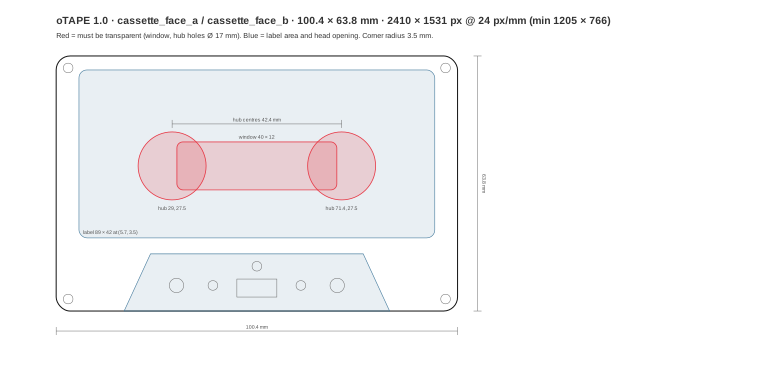
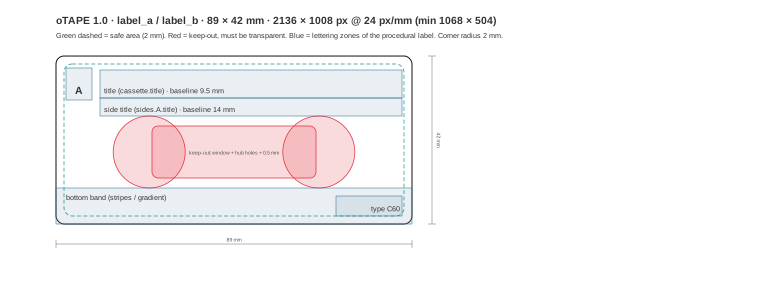
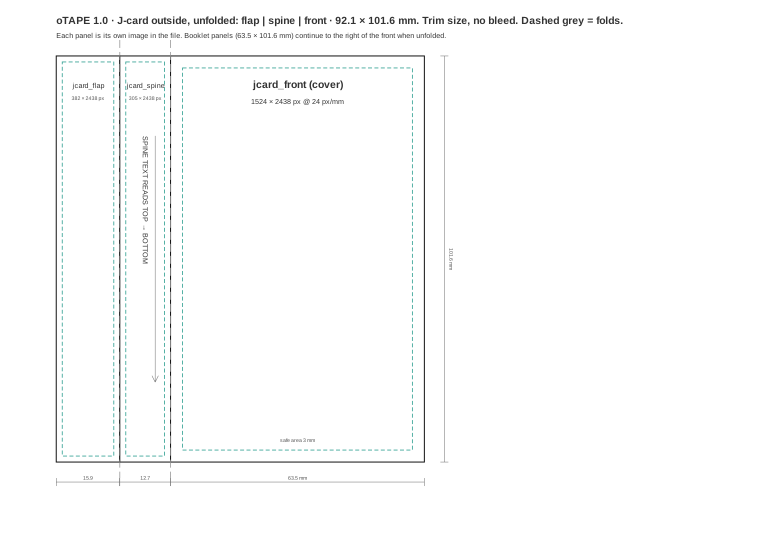
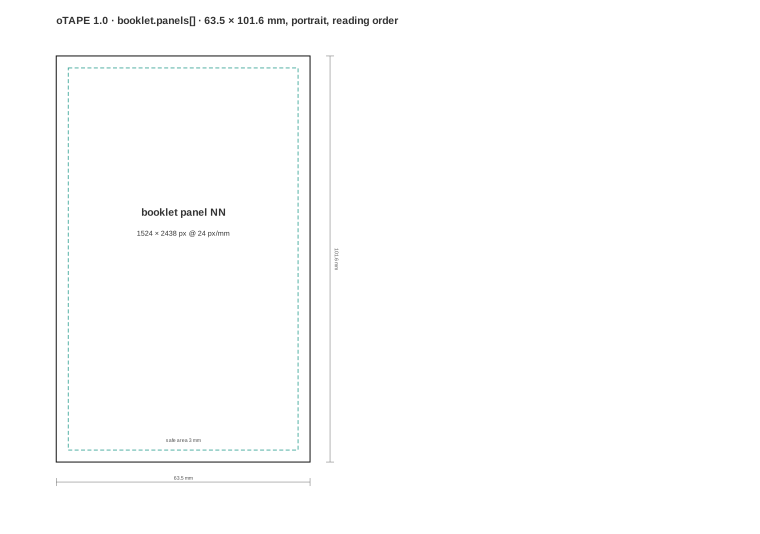
Shell and label artwork, the J-card's front, spine and back flap, a fold-out booklet, liner notes and a dedication. Every image slot has a fixed size in millimeters, so artwork made in one app fits correctly in any other.
flap 25.4spine 12.7front 63.5 mm
| Slot |
mm |
Recommended px |
| Cassette face A / B |
100.4 × 63.8 |
2410 × 1531 |
| Label A / B |
89.0 × 42.0 |
2136 × 1008 |
| J-card front |
63.5 × 101.6 |
1524 × 2438 |
| J-card spine |
12.7 × 101.6 |
305 × 2438 |
| J-card back flap |
25.4 × 101.6 |
610 × 2438 |
| Booklet panel |
63.5 × 101.6 |
1524 × 2438 |
| Thumbnail |
square |
1024 × 1024 |
24 px/mm recommended, 12 px/mm minimum, aspect ratio within ±1%. Shell and label images must be transparent over the window and hub holes, so the player's reels show through.
07 The reference app
oTAPE Studio.
A three-piece hi-fi for your Mac: the SP-2 CD/MP3 source player and the TU-01 internet radio tuner, both wired into the OT-1 cassette deck. Load your music or tune in a station, press REC, and the tape records in real time. Pause the player and the deck records silence. Save, and you have an .otape file. New in 1.2: tape sound, so any tape can play through a machine of the era.
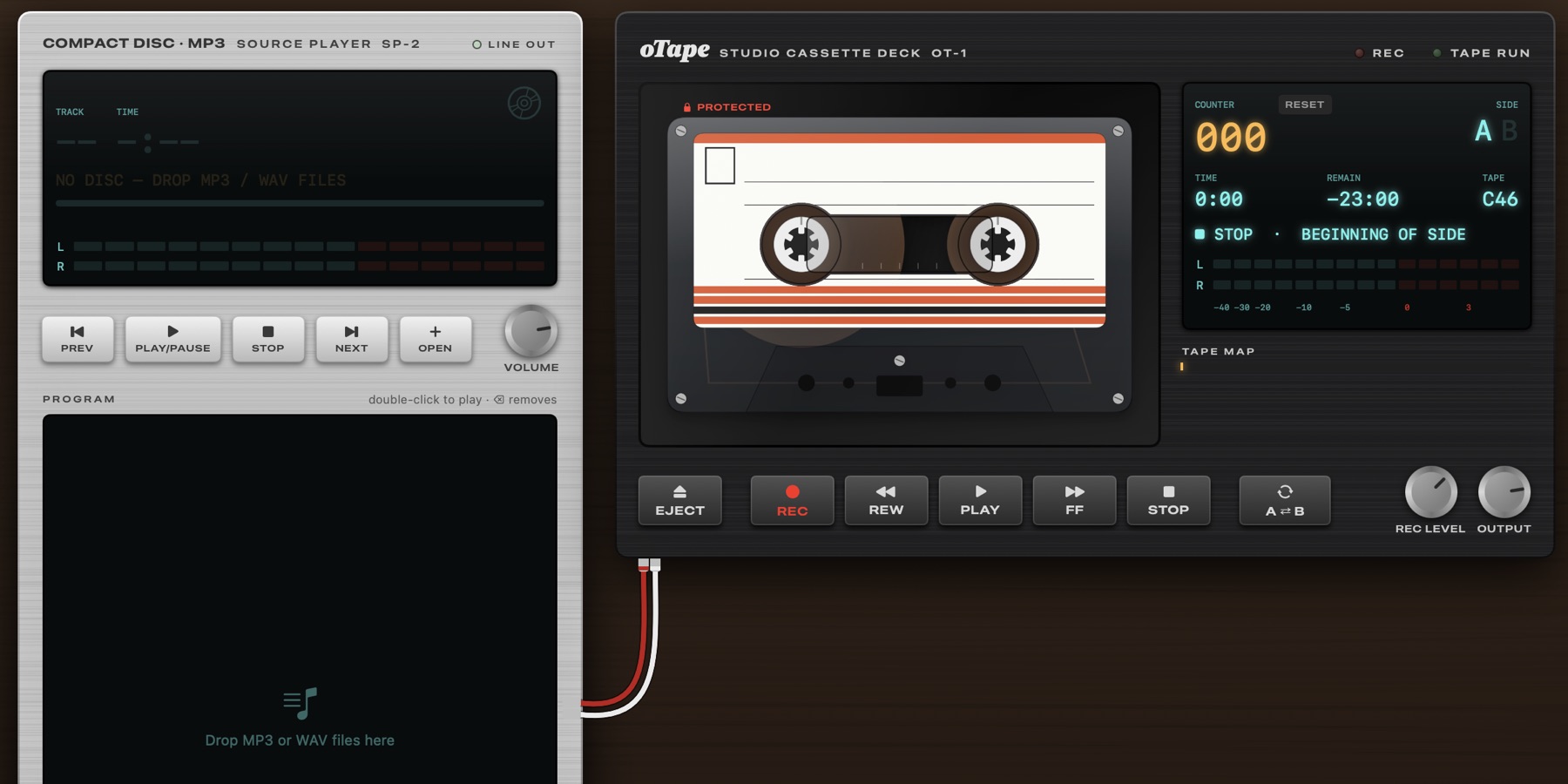
- Records in real timeThe head overwrites the tape in place at 44.1 kHz. Blank tape stays blank, and nothing is recorded faster than it plays.
- Radio on the dialThe TU-01 tunes about 50,000 stations from the Radio Browser directory. Song titles become track markers on the tape and lines on the J-card.
- Blanks and a designerC46 to C120 blanks with working tape counters and reels. The designer covers the shell, label, lettering, J-card, artwork and record tabs, starting from eight presets.
- Careful with your filesSaves AAC at 256 kb/s and re-encodes only the sides you changed. Data written by other oTAPE apps is left intact.
08 In your browser
Studio,
on the web.
oTAPE Studio Web is a cassette deck that runs in your browser, on any computer. Open a tape or start a blank one, then record onto it in real time from a playlist of your own songs, an internet radio station or any audio input. Save, and you have an .otape file. Nothing to install, no account, and your cassettes and songs never leave your device.
- Three sourcesA player for your MP3, AAC, WAV and FLAC files, the Radio Browser directory of internet stations, and line in from any audio input of the computer.
- A real transportPlay, wind at speed, flip and stop at the ends. Reels and counter follow the tape-pack model, and the record tab protects finished sides.
- Checks every tapeOpens any oTAPE 1.0 cassette, validates it fully and names every problem with its section of the spec. Blanks from C46 to C120, or any custom length.
- InstallableAdd it as an app and it opens
.otape files from your system. Deck keys and media keys work, and it saves AAC at 256 kb/s.
09 For developers
Write a player
in an afternoon.
The spec is open: anyone can implement it in free or commercial software, with no royalties and no permission needed. A basic player comes down to the five steps below.
- Open the ZIP and read
manifest.json. Check format == "oTAPE" and that the major version is 1.
- For each side, decode
audio.file and treat it as exactly recorded_frames long. The rest of the side is blank tape.
- Play from the head position. Use FF and REW to wind instead of jumping. Flipping maps position p to L − p.
- Draw the cassette from
appearance, or from the artwork images if there are any.
- Remember the head position locally, per
cassette.id. Playing never modifies the file.
Validate a cassette
# optional: enables the JSON Schema check
pip install -r tools/requirements.txt
python3 tools/otape_validate.py my-mixtape.otape
VALID my-mixtape.otape
Implementations
| Name |
Platform |
Role |
| oTAPE Studio |
macOS 14+ |
Reference recorder and player, by Jan Osio. Download .dmg |
| oTAPE Studio Web |
Chrome, Edge, Safari |
Recorder and player in the browser, by Jan Osio |
| oTAPE Web Deck |
Any modern browser |
Player, on this page |
Built something that reads or writes oTAPE? Open a pull request to add it to the list.
Own the tape.
Not the platform.
No feed decides what plays next. No account, server or subscription sits between you and a tape someone made for you. oTAPE is open so your cassettes can outlive any app that plays them, including ours.
No cloud · no accounts · just tapes
 Instagram Engineering
 Shopify Engineering