Introduction
Time series analysis has one of the most fragmented library ecosystems in Python. Depending on whether you need statistical forecasting, machine learning pipelines, deep learning models, or anomaly detection, you'll reach for different tools — each with its own API, data format expectations, and assumptions about your problem.
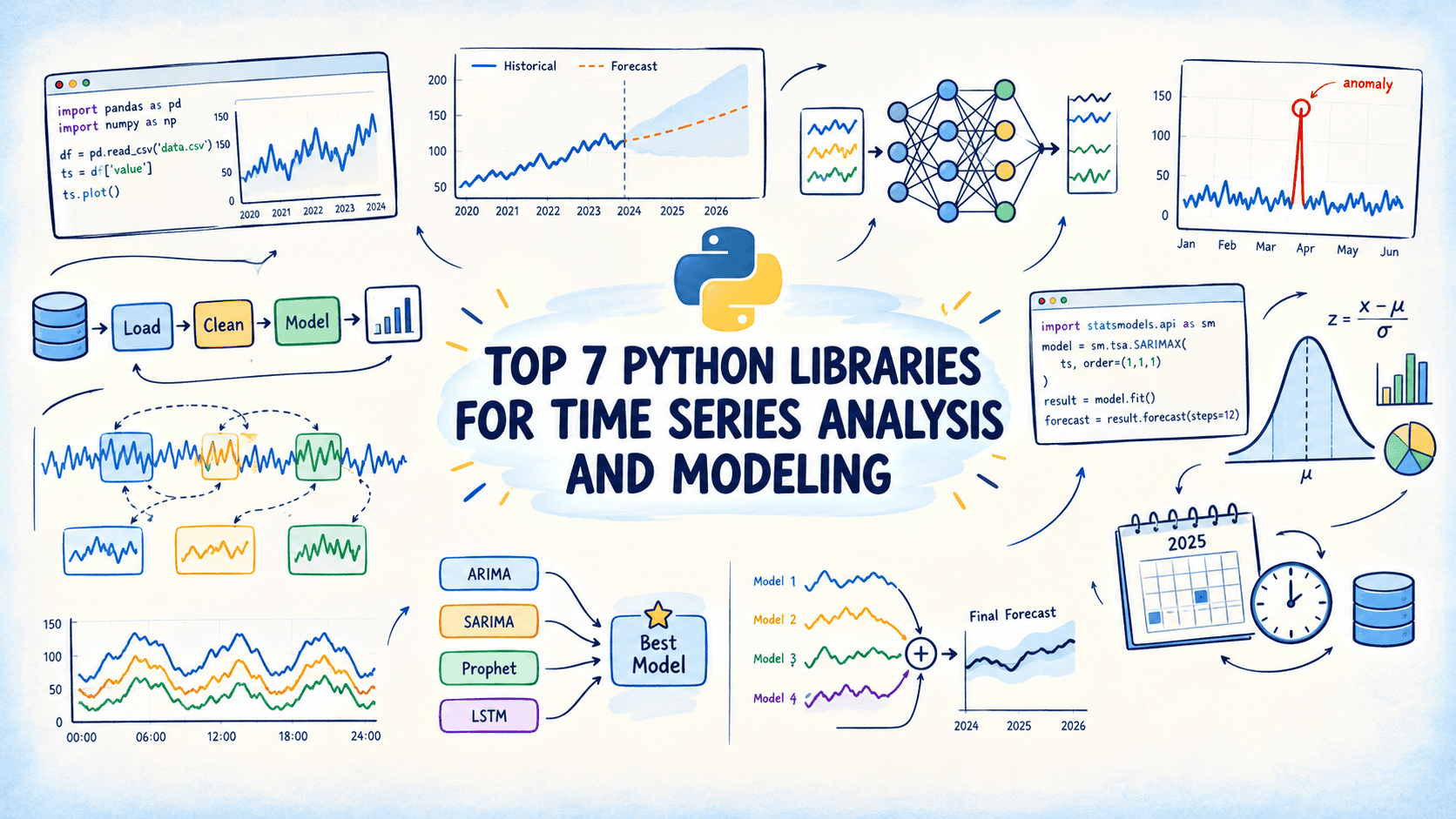
This article covers seven useful Python libraries that collectively span the full spectrum of time series work, including:
- Classical and automated statistical forecasting
- Scalable machine learning pipelines and model selection
- Deep learning and ensemble-based forecasting
- Anomaly detection, outlier analysis, and motif discovery
Let's explore them.
1. Building Statistical Forecasting Models with statsmodels
When interpretability is just as important as predictive power, statsmodels is the first library to reach for. It is the foundation of classical time series analysis in Python, implementing the statistical models that have been workhorses in economics, finance, and operations research for decades.
What makes statsmodels useful:
- Implements the full ARIMA family, including ARIMA and SARIMAX for seasonal data and exogenous regressors, with confidence intervals, Akaike information criterion (AIC) and Bayesian information criterion (BIC) scores, and diagnostic plots included in the output
- Provides exponential smoothing models through ETSModel, covering additive and multiplicative trend and seasonal components
- Includes statistical tests for pre-modeling diagnostics: the Augmented Dickey-Fuller test and KPSS test for stationarity, and the Ljung-Box test for residual autocorrelation
Resources: statsmodels Time Series Analysis documentation and statsmodels examples
2. Automating Model Selection with pmdarima
Finding the right ARIMA order — the (p, d, q) parameters — is one of the most tedious steps in classical forecasting. pmdarima solves this by bringing R's auto.arima functionality to Python, wrapping statsmodels under the hood and automating the model selection process.
The following are the key features of pmdarima:
auto_arima runs a stepwise search over candidate ARIMA orders, scoring by AIC or BIC, without manual interpretation of autocorrelation and partial autocorrelation plots- Follows scikit-learn's fit/predict interface, so it slots into existing scikit-learn pipelines
- Tests for seasonality automatically before adding SARIMA terms, reducing the risk of forcing seasonal structure that isn't there
Note: pmdarima is the right tool for a fast statistical baseline, or for automated forecasting across many series. Its GitHub repository shows development has slowed in recent releases, so check the changelog before pinning it into a new production pipeline.
Resources: pmdarima documentation and pmdarima user guide
3. Building Unified Machine Learning Pipelines with sktime
sktime provides a unified interface for time series learning tasks — forecasting, classification, regression, clustering, and annotation — spanning classical statistics, machine learning, and deep learning. It therefore tackles the fragmentation problem in Python's time series ecosystem that we started this article with.
Why sktime should find a place in your time series toolkit:
- One consistent interface across estimators, so switching between an ARIMA model, a gradient boosting regressor, and a neural network is a small code change
- Composite model building — pipelining, ensembling, tuning, reduction — for chaining preprocessing and forecasting into a single reproducible workflow
- Time-series-aware cross-validation that respects temporal order, avoiding the leakage generic cross-validators introduce on sequential data
- Direct interfaces to related libraries, including scikit-learn, statsmodels, tsfresh, and PyOD
sktime is the library to use when a workflow needs to be systematic, reproducible, and easy to compare across model families. Read Building Time-Series Machine Learning Models with sktime in Python for a practical introduction to sktime.
Resources: sktime documentation and sktime Notebook Examples
4. Forecasting at Scale with Darts
Darts takes a broader-toolkit approach than sktime. Instead of unifying access to other libraries' algorithms, it implements classical, machine learning, and deep learning models directly, with an emphasis on probabilistic forecasting and multi-series scale.
What makes Darts interesting:
- Produces probabilistic forecasts across most models, returning prediction intervals rather than single-point estimates
- Trains a single global model across large collections of related series at once, rather than one model per series
- Includes a backtesting workflow for simulating historical forecasts across multiple horizons
- Ships an anomaly detection module that wraps forecasting or filtering models into detectors, or applies PyOD-style scorers directly to time series
Darts also covers a broad model catalog in one package, spanning exponential smoothing, ARIMA, gradient-boosted regression, and several deep learning architectures.
Resources: Darts documentation and Darts examples and tutorials
5. Detecting Temporal Patterns with stumpy
Most time series libraries focus on forecasting. stumpy, however, computes the matrix profile, a structure recording the distance between every subsequence in a series and its nearest neighbor. That structure supports motif discovery, discord detection, and pattern discovery without labeled data.
What makes stumpy helpful for pattern discovery in time series:
- Motif discovery surfaces the most frequently recurring subsequences — useful for sensor data, user activity logs, or equipment cycles, without labeling
- Discord detection finds the subsequences most unlike everything else, a parameter-light way to flag unusual events
- Scales through CPU parallelization and GPU acceleration for high-frequency or long-running data
- Supports additional tasks on top of the matrix profile, including shapelet discovery, streaming updates, and time series chains
stumpy is often the right tool when the question is "what patterns exist in this data" rather than "what happens next." It complements forecasting libraries in production monitoring.
Resources: stumpy documentation and stumpy GitHub repository
6. Scaling Anomaly Detection with PyOD
For anomaly detection on tabular and multivariate feature matrices, PyOD is the most comprehensive library available. Its current major version implements more than 60 detection algorithms under one interface and has expanded beyond tabular data to also cover time series, graph, text, and image data.
What makes PyOD useful for outlier detection:
- Covers the full spectrum in one package, including proximity-based, linear, ensemble, and deep learning methods
- One consistent interface across detectors, with continuous anomaly scores rather than only binary labels
- Utilities for parallel training and evaluation, cutting the boilerplate involved in building anomaly detection experiments
- Recent releases add agentic workflows for describing a detection task in plain language, on top of the existing programmatic API
PyOD is still most often used on engineered feature matrices — rolling statistics, lag features, frequency components — rather than on raw sequences directly.
Resources: PyOD documentation and PyOD GitHub repository
7. Forecasting with Deep Learning Using NeuralForecast
When classical and machine learning-based models plateau, deep learning can close the gap. NeuralForecast by Nixtla brings a large collection of neural forecasting architectures to Python in a production-friendly package.
The features of NeuralForecast include the following:
- Implements more than 30 forecasting architectures in one library, from recurrent networks to transformer-based and large language model-based models like PatchTST, TimesNet, and TimeLLM
- Supports exogenous variables and static covariates, plus interpretability methods for trend, seasonality, and feature contributions
- Includes automatic hyperparameter tuning and built-in temporal cross-validation
- Built for multi-series forecasting, accepting long-format data with a series identifier column so one global model can cover thousands of related series
NeuralForecast is part of the broader Nixtla ecosystem, alongside StatsForecast for fast classical models and MLForecast for gradient boosting.
Resources: NeuralForecast documentation and NeuralForecast GitHub repository
Summary
These seven libraries cover the full time series stack, from interpretable statistical models to scalable deep learning and unsupervised anomaly detection. Here's an overview:
| Library |
Category |
Useful Features |
Best For |
| statsmodels |
Statistical modeling |
Full ARIMA/SARIMAX family with rigorous diagnostics |
Interpretable, stakeholder-ready forecasts |
| pmdarima |
Automated model selection |
Automates ARIMA order search via auto_arima |
Fast statistical baselines |
| sktime |
Unified machine learning pipelines |
One interface across forecasting, classification, and clustering |
Reproducible, comparable machine learning workflows |
| Darts |
End-to-end forecasting |
Probabilistic, multi-series global models plus anomaly detection |
Scaling forecasts with uncertainty across many series |
| stumpy |
Pattern discovery |
Matrix profile for motif and discord discovery |
Finding patterns or anomalies without labels |
| PyOD |
Anomaly detection |
60+ algorithms under one API, now multimodal |
Tabular/multivariate anomaly detection at scale |
| NeuralForecast |
Deep learning forecasting |
30+ neural architectures with global training |
Pushing accuracy on complex, large-scale series |
The best way to get comfortable with any of these libraries is to apply them to the same dataset and compare results. Understanding why models work the way they do for the given problem teaches you more about your data than any benchmark table can.
Bala Priya is a developer, educator, and technical writer based in India. She writes about programming, data science, machine learning, and AI, with a focus on making complex technical ideas practical and approachable. She creates tutorials, how-to guides, and deep dives that help developers build, solve problems, and understand complex technical concepts. Her technical interests include LLM applications, agentic AI, graph algorithms, computer vision, explainable AI, and ML systems. When she’s not writing or coding, Bala is usually reading classic literature, epic fantasy, or speculative fiction. She also enjoys talking about books, learning new things, and sharing what she learns with the developer community.
 Instagram Engineering
 Shopify Engineering