Image by Author
Introduction
As AI-generated media becomes increasingly powerful and common, distinguishing AI-generated content from human-made content has become more challenging. In response to risks such as misinformation, deepfakes, and the misuse of synthetic media, Google DeepMind has developed SynthID, a collection of tools that embed unnoticeable digital watermarks into AI-generated content and enable strong identification of that content later.
By including watermarking directly into the content generation process, SynthID helps verify origin and supports transparency and trust in AI systems. SynthID extends across text, images, audio, and video with tailored watermarking for each. In this article, I’ll explain what SynthID is, how it works, and how you can use it to apply watermarks to text.
At its center, SynthID is a digital watermarking and detection framework designed for AI-generated content. It is a watermarking framework that injects unnoticeable signals into AI-generated text, images, and video. These signals survive compression, resizing, cropping, and common transformations. Unlike metadata-based approaches like Coalition for Content Provenance and Authenticity (C2PA), SynthID operates at the model or pixel level. Instead of appending metadata after generation, SynthID embeds a hidden signature within the content itself, encoded in a way that is invisible or inaudible to humans but detectable by algorithmic scanners.
SynthID's design goal is to be invisible to users, resilient to distortion, and reliably detectable by software.
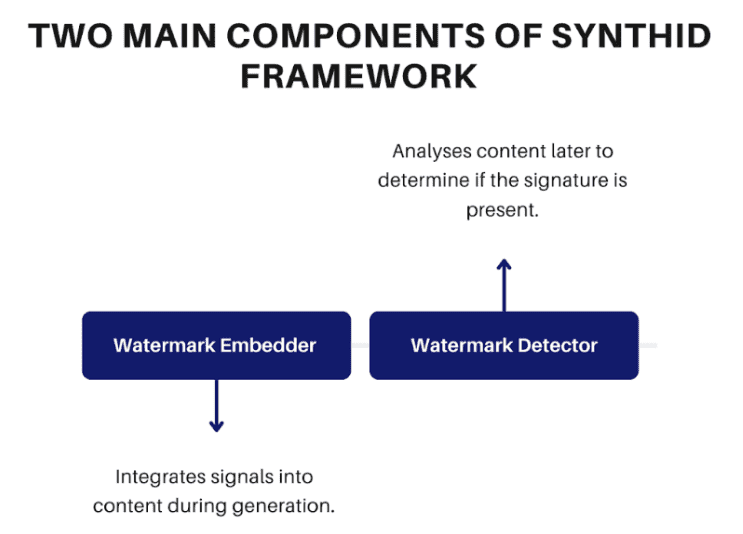
SynthID is integrated into Google’s AI models, including Gemini (text), Imagen (images), Lyria (audio), and Veo (video). It also supports tools such as the SynthID Detector portal for verifying uploaded content.
// Why SynthID Is Important
Generative AI can create highly realistic text, images, audio, and video that are difficult to differentiate from human-created content. This brings risks such as:
- Deepfake videos and manipulated media
- Misinformation and deceptive content
- Unauthorized reuse of AI content in contexts where transparency is required
SynthID provides original markers that help platforms, researchers, and users trace the origin of content and rate whether it has been synthetically produced.
// Technical Principles Of SynthID Watermarking
SynthID’s watermarking approach is rooted in steganography — the art of hiding signals within other data so that the presence of the hidden information is imperceptible but can be recovered with a key or detector.
The key design goals are:
- Watermarks must not reduce the user-facing quality of the content
- Watermarks must survive common changes such as compression, cropping, noise, and filters
- The watermark must reliably indicate that content was generated by an AI model using SynthID
Below is how SynthID implements these goals across different media types.
Text Media
// Probability-Based Watermarking
SynthID embeds signals during text generation by manipulating the probability distributions used by large language models (LLMs) when selecting the next token (word or token part).
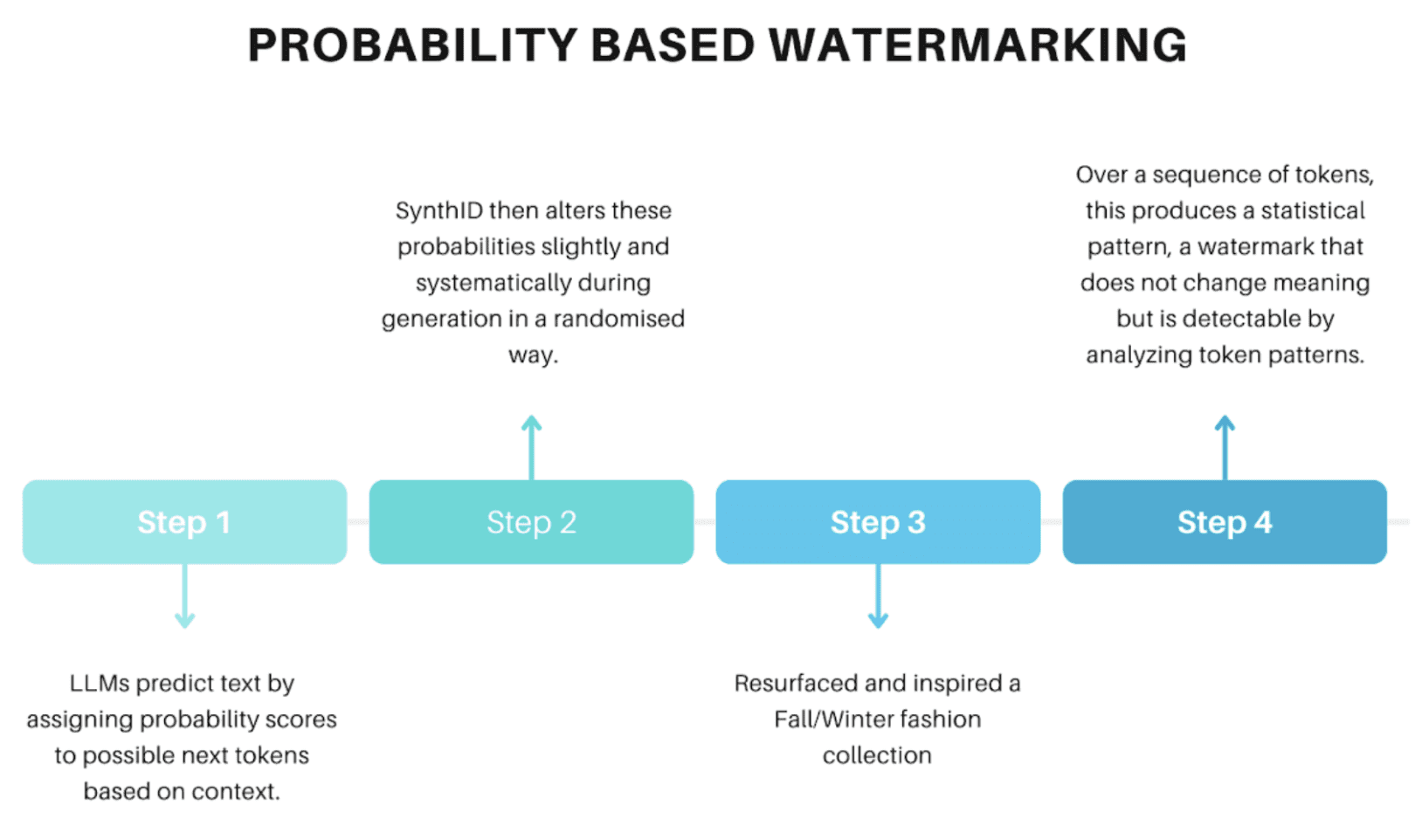
This method benefits from the fact that text generation is naturally probabilistic and statistical; small controlled adjustments leave output quality unaffected while providing a traceable signature.
Images And Video Media
// Pixel Level Watermarking
For images and video, SynthID embeds a watermark directly into the generated pixels. During generation, for example, via a diffusion model, SynthID modifies pixel values subtly at specific locations.
These changes are below human noticeable differences but encode a machine-readable pattern. In the video, watermarking is applied frame by frame, allowing temporal detection even after transformations such as cropping, compression, noise, or filtering.
Audio Media
// Visual-Based Encoding
For audio content, the watermarking process leverages audio’s spectral representation.
- Convert the audio waveform into a time-frequency representation (spectrogram)
- Encode the watermark pattern within the spectrogram using encoding techniques aligned with psychoacoustic (sound perception) properties
- Reconstruct the waveform from the modified spectrogram so that the embedded watermark remains unnoticeable to human listeners but detectable by SynthID’s detector
This approach ensures that the watermark remains detectable even after changes such as compression, noise addition, or speed changes — though you must know that extreme changes can weaken detectability.
Watermark Detection And Verification
Once a watermark is embedded, SynthID’s detection system inspects a piece of content to determine if the hidden signature exists.
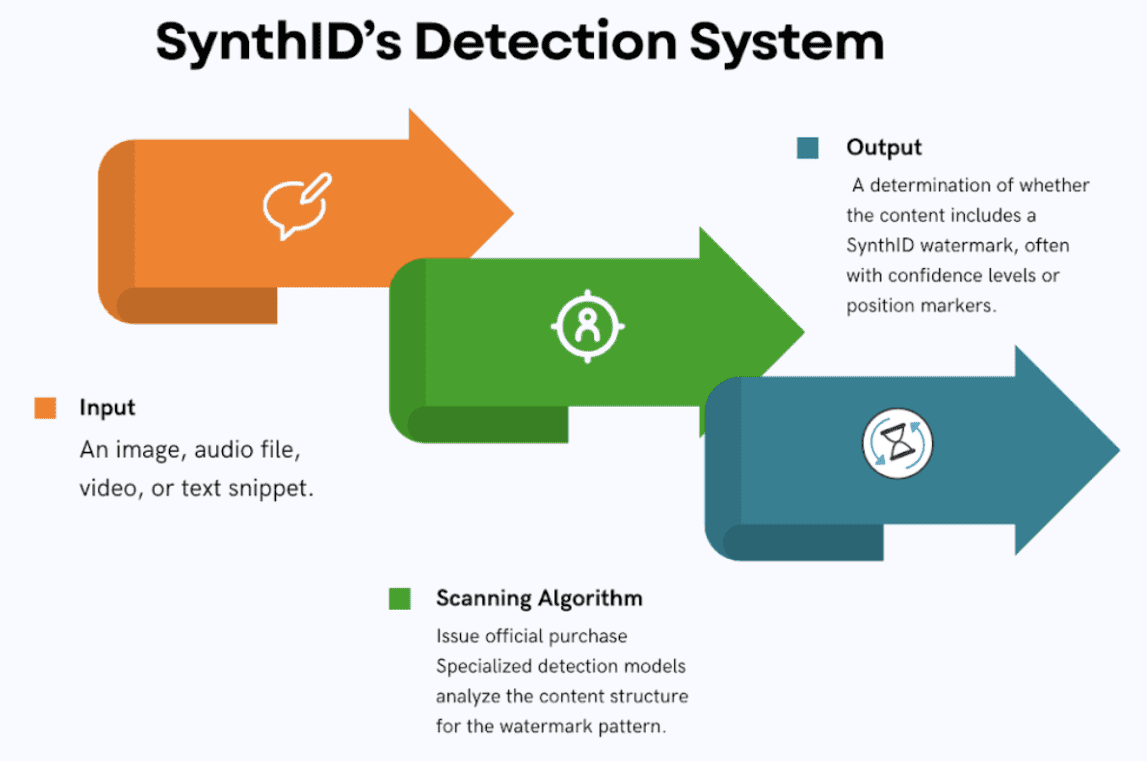
Tools like the SynthID Detector portal allow users to upload media to scan for the presence of watermarks. Detection highlights areas with strong watermark signals, enabling more granular originality checks.
Strengths And Limitations Of SynthID
SynthID is designed to withstand typical content transformations, such as cropping, resizing, and image/video compression, as well as noise addition and audio format conversion. It also handles minor edits and paraphrasing for text.
However, significant changes such as extreme edits, aggressive paraphrasing, and non-AI transformations can reduce watermark detectability. Also, SynthID’s detection primarily works for content generated by models integrated with the watermarking system, such as Google’s AI models. It may not detect AI content from external models lacking the SynthID integration.
Applications And Broader Impact
The core use cases for SynthID include the following:
- Content originality verification distinguishes AI-generated content from human-created material
- Fighting misinformation, like tracing the origin of synthetic media used in deceptive narratives
- Media sources, compliance platforms, and regulators can help track content origins
- Research and academic integrity, supporting copied and responsible AI use
By embedding constant identifiers into AI outputs, SynthID enhances transparency and trust in generative AI ecosystems. As adoption grows, watermarking may become a standard practice across AI platforms in industry and research.
Conclusion
SynthID represents an influential advancement in AI content traceability, embedding cryptographically strong, unnoticeable watermarks directly into generated media. By leveraging model-specific influences on token probabilities for text, pixel modifications for images and video, and spectrogram encoding for audio, SynthID achieves a practical balance of invisibility, strength, and detectability without compromising content quality.
As generative AI continues to change, technologies like SynthID will play an increasingly central role in ensuring responsible deployment, challenging misuse, and maintaining trust in a world where synthetic content is ubiquitous.
Shittu Olumide is a software engineer and technical writer passionate about leveraging cutting-edge technologies to craft compelling narratives, with a keen eye for detail and a knack for simplifying complex concepts. You can also find Shittu on Twitter.
 Instagram Engineering
 Shopify Engineering