Sponsored Content
The Biggest Challenge Teams Face With AI Today—and the Platform That Solves It
This is how the vast majority of teams currently use AI applications: one member subscribes to ChatGPT, another trusts Claude; the software developer uses an entirely different code editor, some marketer spends money on Midjourney, while the data team is building its own pipeline with raw APIs. In other words, everyone is working alone and separately, spending money on the tools that duplicate each other and cannot be integrated.
This approach comes at a price. \$20 monthly fee for ChatGPT Plus. \$20 for Claude Pro. \$20 for Gemini Advanced. \$30+ monthly fee for generating images. Another \$20 for a coding tool. This amounts to \$100+ monthly fee for each member of a team without taking into account the time lost by switching between tabs and explaining the context to each tool separately.
And the price is not even the main problem here. The problem is the fragmentation. Each tool knows something about your work and is not aware of anything that the other tools know. You are copying the same document to three different tools. You are always repeating yourself. And whenever you need AI to do something that involves more than just answering questions, such as completing complex tasks, building things, or functioning on their own in the background – most of those programs just aren’t able to do it.
This is the void that Abacus AI aims to fill. And they are doing it with an all-in-one platform for AI rather than another chatbot. Whether the company lives up to its promises will be revealed in this review.
TL;DR — The Quick Version of Abacus AI
Before we go deep, here's what you need to know upfront:
- One subscription is enough instead of many: for \$10 per month, you will get access to 100+ top AI models in the world such as GPT-5.5, Claude Opus 4.8, Gemini 3.1 Pro, Grok 4.3, DeepSeek, Qwen, and other similar models.
- This is more than a chatbot: Abacus AI has agents which can perform tasks autonomously, build applications, conduct research and automate workflows without your constant guidance.
- There are always-on agents available: there are agents such as Abacus Claw and Hermes which work 24/7 without interruption even in offline mode.
- Programmers have a good suite at hand: Abacus AI Desktop is a complete development suite with features like CLI, Code Editor, Listener and CoWork modes. It has been ranked among the top three globally in benchmarks.
- The creative side of it is also taken care of: Abacus AI Studio integrates over 15+ image models and 12+ video models including Sora 2, Veo 3.1, Midjourney and FLUX.
- Good pricing structure: At just \$10/month for basic, \$20/month for Pro with full access to all the agents, and customized for enterprises.
- Enterprise level security: SOC-2 Type 2 certification, HIPAA compliant, no training on your data.
- Faults of the platform: Learning curve. Your credits may be exhausted sooner than you expect when doing hard work. Varying support response times.
- Useful for: Developers, entrepreneurs, analysts, content creators, and enterprises looking for consolidation of their AI stack and getting things done.
What Is Abacus AI? One Platform, Every AI Tool
The Abacus AI is best described as an all-in-one AI platform rather than a single AI product. It's essentially a platform which connects you to the greatest AI models in the world along with providing you with the infrastructure needed to make use of the models in your professional life.
The platform has been developed in two layers. The first layer of the platform includes ChatLLM which is the super-assistant aimed towards the consumer base and used daily by users.
You can consider it to be the interface layer where models can be accessed and documents analyzed and images created.
The second layer is made up of agent and infrastructure tools: Abacus AI Agent (DeepAgent), Claw, Hermes, AppLLM, Desktop, Studio, SuperComputer, and RouteLLM. These services perform all heavy lifting – multi-step task execution, continuous background operations, building and deploying apps, as well as providing the infrastructure for hosting whatever you make.
The distinctive feature of Abacus AI is that both layers are part of the same subscription service. You don't have to pay separately for different services. The basic package costs \$10 and includes the interface layer plus access to agents. The Pro package worth \$20 provides the whole layer of agents' infrastructure.
The platform is also scalable to enterprise. Enterprise level organizations make use of Abacus AI for MLOps, custom model training, real time data pipelines, and deployment of AI in entirety of the department - same company which provides a chatbot for just \$10 per month.
Who Owns Abacus AI and Is Abacus AI Legit?
The firm Abacus AI was launched in the year 2019, initially under the name of RealityEngines.AI, by Bindu Reddy (CEO), Arvind Sundararajan (CTO), and Siddartha Naidu. All three founders hail from high-ranking technical positions in Google, Amazon, and Uber respectively. Reddy was in charge of Forecasting and Personalization in AWS.
Sundararajan had been running the Autonomous Systems department in Uber. Naidu was one of the creators of Google BigQuery and Amazon fulfillment systems.
The firm has secured over \$90 million in funding from reputable institutional investors like Eric Schmidt’s venture capital firm, Tiger Global, and Index Ventures.
Is Abacus AI legitimate? Absolutely. Abacus AI is a legitimate company with legitimate founders, financial backing, and a legitimate platform. The platform isn't some fly-by-nigh wrapper AI system. It has been developed for years and currently works in a production environment of companies which require reliability.
With all this being said, "legitimate" does not mean "without any faults." The users of Abacus AI noted their problems with the crediting system, agent's mistakes, and slow response to their questions. This information is important and will be discussed in more details in the pros and cons section.
Abacus AI Features: The Complete Product Ecosystem
ChatLLM — The AI Super-Assistant
ChatLLM is referred to as the first AI super-assistant and is the app that users spend the majority of their time on. What’s the idea behind the product? Instead of maintaining five separate AI subscriptions, get them all in one place.
Models currently available:
- OpenAI: GPT-5.5, GPT-5.5 Thinking, GPT-5.5 Pro, Codex 5.3, o3, GPT Image
- Anthropic: Claude Sonnet 4.6, Claude Opus 4.8
- Google: Gemini 3.1 Pro, Gemini 3.5 Flash
- xAI: Grok 4.3
- Open-source: DeepSeek v4, Qwen 3.7 Max, Kimi 2.7 Thinking, GLM 5.2, and 100+ others
New models are typically added within 24–48 hours of public release, which matters if you're trying to stay current with the model landscape.
What ChatLLM includes beyond chat:
- Document analysis: Upload PDFs, Word documents, PowerPoints, images — the AI analyzes and comments on them.
- Data analysis: Process CSVs, Excel files, create charts, do exploratory data analysis.
- Image generation: GPT Image, Nano Banana Pro, FLUX Pro, Flux Kontext, Seedream, Recraft, Ideogram, DALL-E.
- Video generation: Through Abacus AI Studio (Sora 2, Veo 3.1, Kling AI v3, Seedance 2.0).
- Web search: Real-time web search so you are not limited by training cutoffs.
- Code Playground: Execute code snippets inside the chat.
- Text humanization: Rewrite text in professional, humorous, or caring styles.
- Custom instructions: Save your settings and use them in all conversations.
- AI Engineer: Create custom bots and AI agents without programming.
- Team collaboration: Unlimited team members, shared projects and chats.
- Enterprise integrations: Google Drive, Gmail, Google Calendar, Slack, Microsoft Teams, Confluence, Jira.
- Mobile apps: iOS and Android with voice support, including voice-only mode.
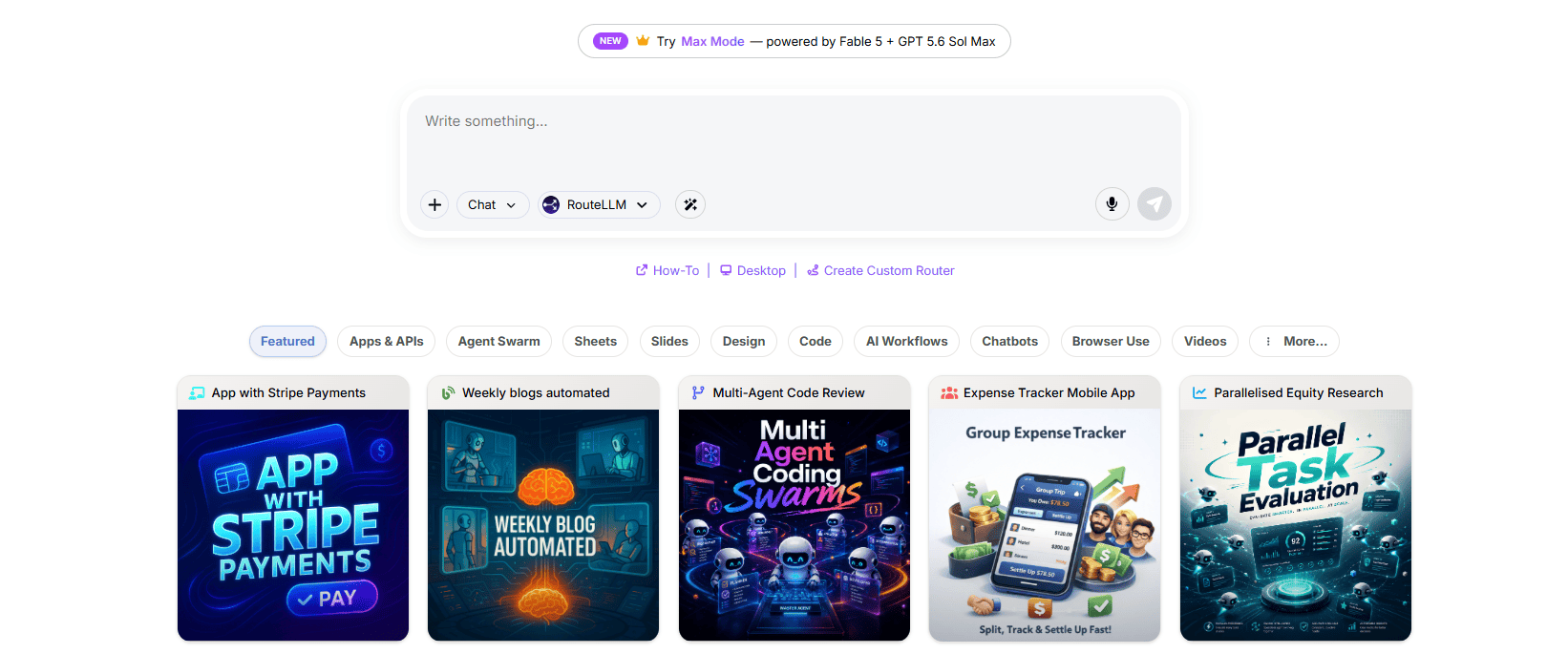
Usage limits are notably generous. ChatLLM allows thousands of text-based messages on top models before triggering rate limits — Abacus claims roughly 10x more tokens than competing services. Resource-intensive tasks like video generation or complex agentic workflows use a credit system, which requires monitoring for heavy users.
Related review: Check out the detailed review of ChatLLM by Abacus AI.
RouteLLM — Intelligent Model Routing
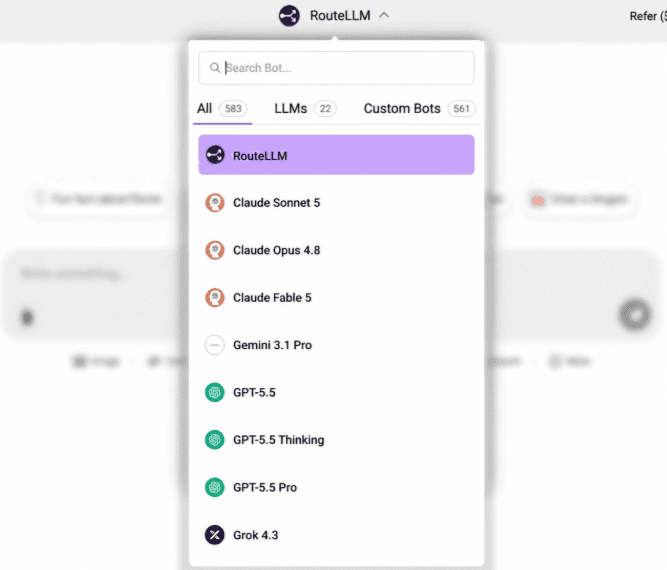
Most users don't want to manually choose which AI model handles each task. RouteLLM solves this automatically.
It's an intelligent routing layer embedded in ChatLLM that analyzes your prompt and selects the most suitable model:
- Coding tasks - coding-optimized models (Codex 5.3, DeepSeek).
- Research and reasoning - reasoning-focused models.
- Creative writing - generation-optimized models.
- Complex multi-step tasks - the most capable available model.
For developers, RouteLLM is also available as a standalone API. It provides a single unified endpoint to call any LLM — open-source or closed — with automatic failover, competitive pricing (RouteLLM matches or beats provider-listed prices), and high uptime. Included with the ChatLLM subscription.
This is genuinely useful for teams building AI-powered products who want flexibility without managing multiple API keys and integrations.
Abacus AI Agent (DeepAgent) — The Autonomous Executor
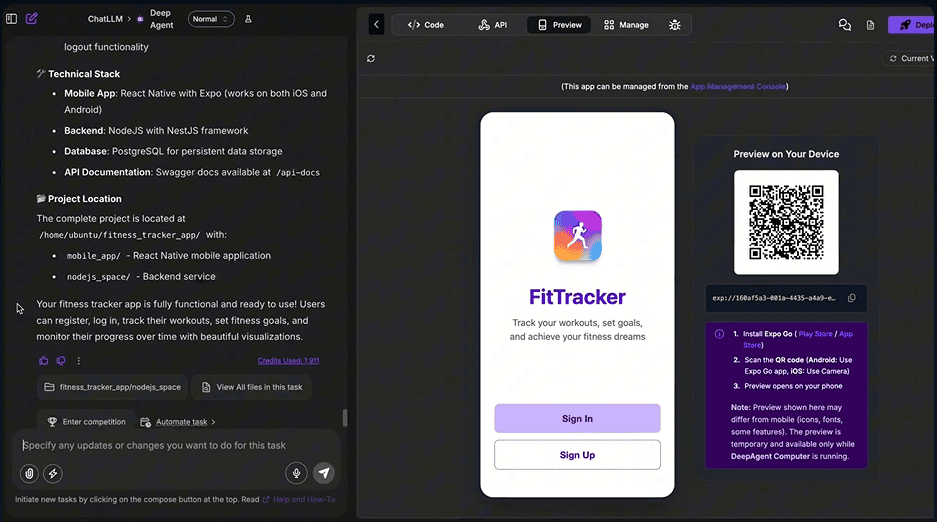
This is the thing about Abacus AI that continually amazes everyone. The Abacus AI Agent (Also known as "DeepAgent") is a general-purpose autonomous agent that performs complex tasks, rather than just explaining them.
It makes all the difference. Most of the AI products react to your questions. Abacus AI Agent gets the work done.
Application development and deployment:
Describe your application in simple terms — a two-sided market, a dashboard that shows live data, a game with a scoreboard, a mini-SaaS product with authentication and payment features — and the agent builds it, deploys it, and provides you with its URL. This kind of coding is known as "vibe coding" and in Abacus AI, it really works and isn't just a demo gimmick. And there's a good reason why it's so popular.
Research and analysis:
This agent performs multi-source research with references, produces expert-level research papers (market analysis, financial modeling, competitor research), performs DCF valuations, reviews annual reports, and makes presentations out of raw data.
Automation of business process:
Connect it to Gmail, Jira, Slack, Google Workspace, or GitHub, and this agent will automate routine business workflows such as processing invoices, updating CRMs, performing lead generation, creating and reviewing pull requests, scheduling, and many other.
The structure of it:
There are five levels of this agent's operation: Perception (data input), Planning (breaking down tasks into goal-directed subtasks), Execution (API and tool invocation), Memory (context storage between sessions), and Reinforcement Loop (reinforced learning). It is exactly the reason for its ability to process complex workflows.
Related review: Check out the detailed review of Abacus AI DeepAgent.
Abacus Personal AI Agents — Personalized AI With Claw and Hermes
The Personal AI Agent is a further development from the on-demand agent system. The Personal AI agents are constant 24/7 AI assistants, running on Abacus AI's highly-secure cloud infrastructure and working autonomously, monitoring, executing and reacting even when you are not signed in.
Traditional AI programs need your presence to operate. This is not the case with Personal AI agents; you set them up only once and they continue to work constantly in the background.
At present, there are two Personal AI Agents that Abacus AI provides: Abacus Claw and Abacus Hermes. Both the agents are available through the Pro subscription service plan (\$20/month) and can work at the same time under one subscription.
Abacus Claw — The Always-On Messaging Agent
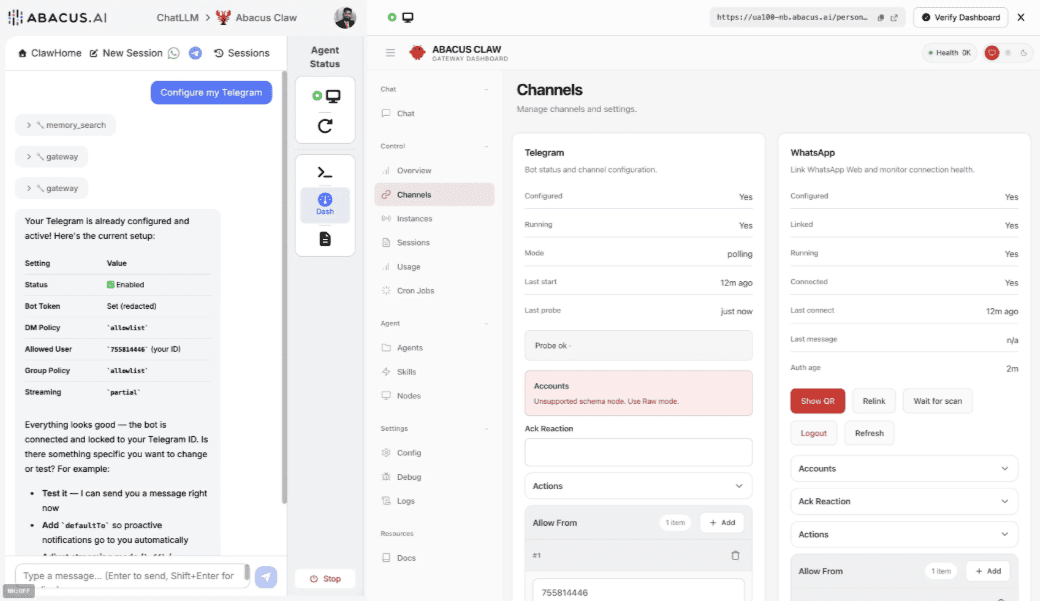
Abacus Claw is a cloud-hosted version of OpenClaw, the open-source AI agent framework. It's designed for users who want a personal AI assistant that's always available across messaging platforms — without managing servers, API keys, or infrastructure themselves.
Key capabilities:
- Connects simultaneously to WhatsApp, Telegram, Slack, and other messaging platforms.
- Runs 24/7, responding to messages even while you sleep.
- Persistent memory — remembers past conversations, preferences, and context.
- Fully customizable personality, tone, and response style.
- Pre-configured AI model options — choose the model that fits your preference.
- Deploy in under a minute — no technical setup required.
How it differs from self-hosting OpenClaw: When you self-host, you're responsible for servers, Node.js configuration, API key management, and security. With Abacus Claw, all of that is managed for you — instant deployment, preloaded credits, 24/7 hosting, and automatic security updates. It's the practical, no-hassle path to a production-ready always-on agent.
Billing: Hosting costs 1 credit per 5 minutes while active. AI model usage is billed separately. You can turn Claw on and off at any time, so you only pay for actual usage.
Best for: Anyone who wants a personal AI available on their preferred messaging apps at all hours — answering questions, handling routine requests, and maintaining continuity across conversations without ever requiring a fresh prompt.
Abacus Hermes — The Self-Evolving Autonomous Agent
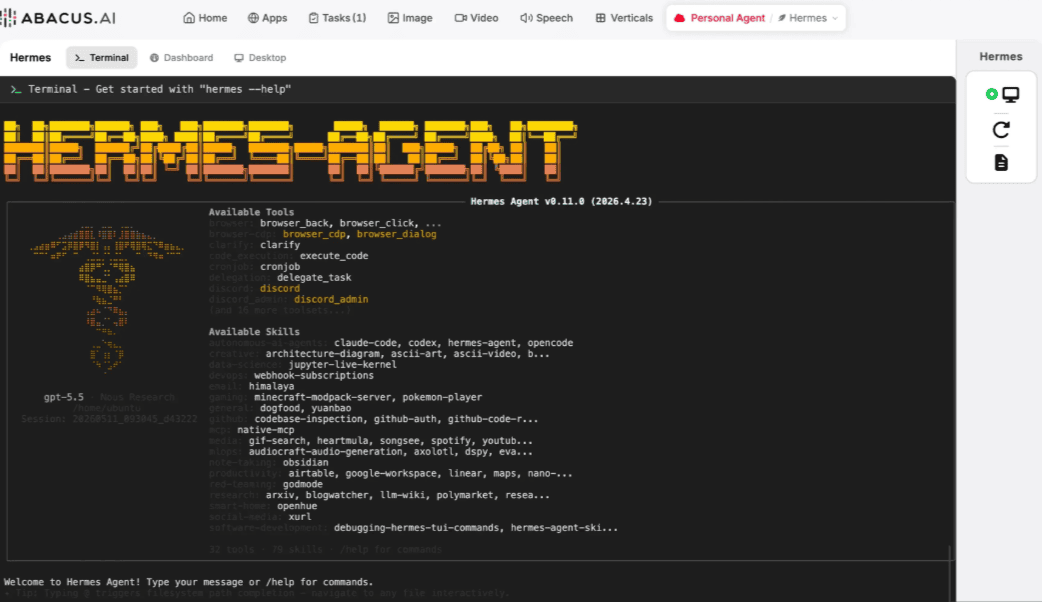
Where Claw handles reactive interactions on messaging platforms, Abacus Hermes handles proactive, complex, multi-step execution. It's the more sophisticated of the two Personal AI Agents — and arguably one of the most technically interesting products in the Abacus AI ecosystem.
What makes Hermes genuinely different:
- It learns from experience. Most AI tools reset between sessions. Hermes builds a persistent knowledge base as it works — storing observations, identifying patterns, and generating reusable skills. The more you use it on a workflow, the better it gets at that specific workflow.
- It maintains memory across sessions. Context, preferences, and learned behaviors carry over automatically. You don't re-explain your goals or repeat background information every session.
- It generates reusable skills. When Hermes successfully completes a complex task, it saves the strategy as a skill. Future tasks of the same type benefit from that saved strategy without starting from scratch.
What Hermes handles best:
- Research and synthesis require multiple sources and decision points.
- Automated workflows spanning many steps, with logic at each stage.
- Long-running tasks that cross session boundaries.
- Coordination tasks where sub-goals need independent planning and execution.
Claw vs. Hermes — At a Glance
| Feature |
Abacus Claw |
Abacus Hermes |
| Primary role |
Always-on messaging assistant |
Complex autonomous task execution |
| Platform |
WhatsApp, Telegram, Slack, and other messaging platforms |
Any workflow or connected system |
| Memory |
Conversation-level persistence |
Deep cross-session learning |
| Self-improvement |
Fixed configured behavior |
Generates and stores reusable skills |
| Best for |
Routine availability, messaging, and responsiveness |
Sophisticated, long-running, multi-step workflows |
AppLLM — Browser-Based AI App Development
AppLLM is for people who want to build and deploy web applications directly from a browser — without any local setup, terminal access, or prior development experience.
It's an AI development agent that takes a description of what you want to build and handles the full stack: frontend, backend, database, and deployment. You describe the app, the AI builds it, and you can iterate in real-time through a conversational interface.
Why it's worth knowing about:
- No local setup — everything runs in the browser.
- Supports full-stack applications, not just static pages.
- One-click deployment to a live URL.
- Built for rapid prototyping — useful for testing ideas before committing engineering resources.
Included with the \$10/month subscription, alongside access to Abacus AI Desktop and ChatLLM. For the price, it's a compelling addition for founders and product teams who need to move quickly from idea to working prototype.
Abacus AI Desktop — The AI Code Editor and Desktop Agent
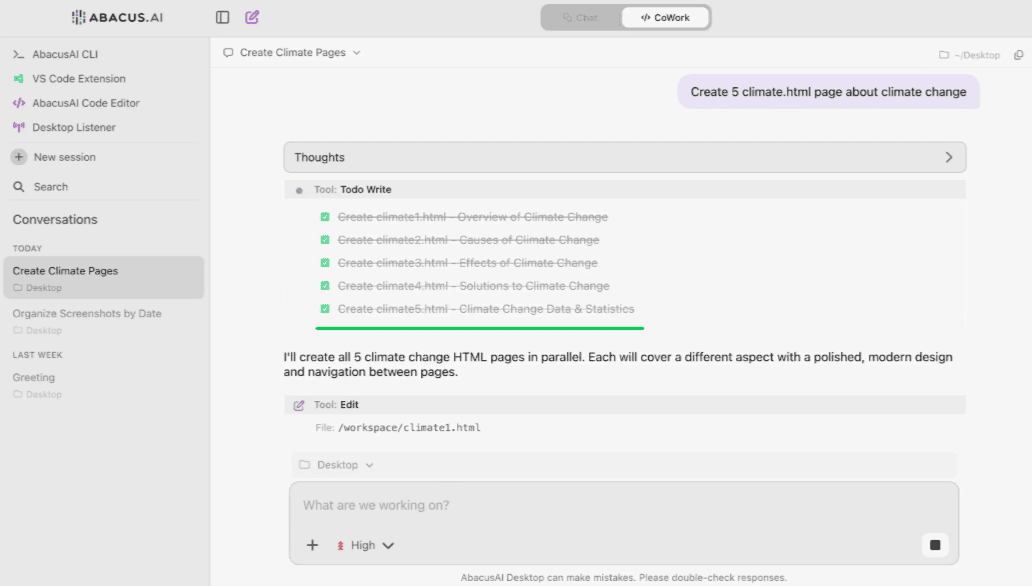
Abacus AI Desktop is the developer-oriented tool among the various tools in the Abacus AI suite. It is an end-to-end desktop application available for macOS, Windows, and Linux operating systems, which consists of five different modes:
- CLI Mode
A terminal-based AI agent. It can be installed using a single command (curl -fsSL https://static.abacus.ai/cli/install.sh | bash on macOS/Linux, or the PowerShell equivalent on Windows) and used in any terminal session.
- Code Editor Mode
Pair programming with debugging, refactoring, code explanation, and GitHub syncing inbuilt in an AI partner. Works alongside your preferred editor, without replacing it.
- Chat Mode
Conversational AI that uses all top models, such as Claude, Gemini, GPT, and Abacus AI Agent router.
- Listener Mode (macOS and Windows only)
Real-time transcription of meetings and answers by the AI Agent during calls. Can be useful if you require reference materials during the call without switching between applications.
- CoWork Mode
The killer app for knowledge workers. CoWork is an agentic mode for advanced knowledge work beyond simple coding all done locally on your own files:
- Reads, writes, organizes, and transforms local files (documents, spreadsheets, presentations, images, data files, code).
- Splits complex processes into parallel sub-processes with sub-agent coordination.
- Creates professional-quality, editable files (Excel files with live formulas, formatted Word docs, PowerPoint presentations, PDF reports).
- Can handle long processes without conversational time-outs or limitations of context.
- Connects to outside services using connectors and browser automation
Benchmark performance: Abacus AI Desktop always performs in the Top 3 on Verified Benchmarks, beating Claude Code and Codex. When teams are benchmarking coding agents by performance, this is an important metric.
Models available: Sonnet 4.6, GPT-5.5, GPT-5.3 Codex, Gemini 3.1 Pro, Opus 4.8, Qwen 3.6 Coder, and the Abacus AI Agent router.
Abacus AI Studio — Creative AI for Images and Videos
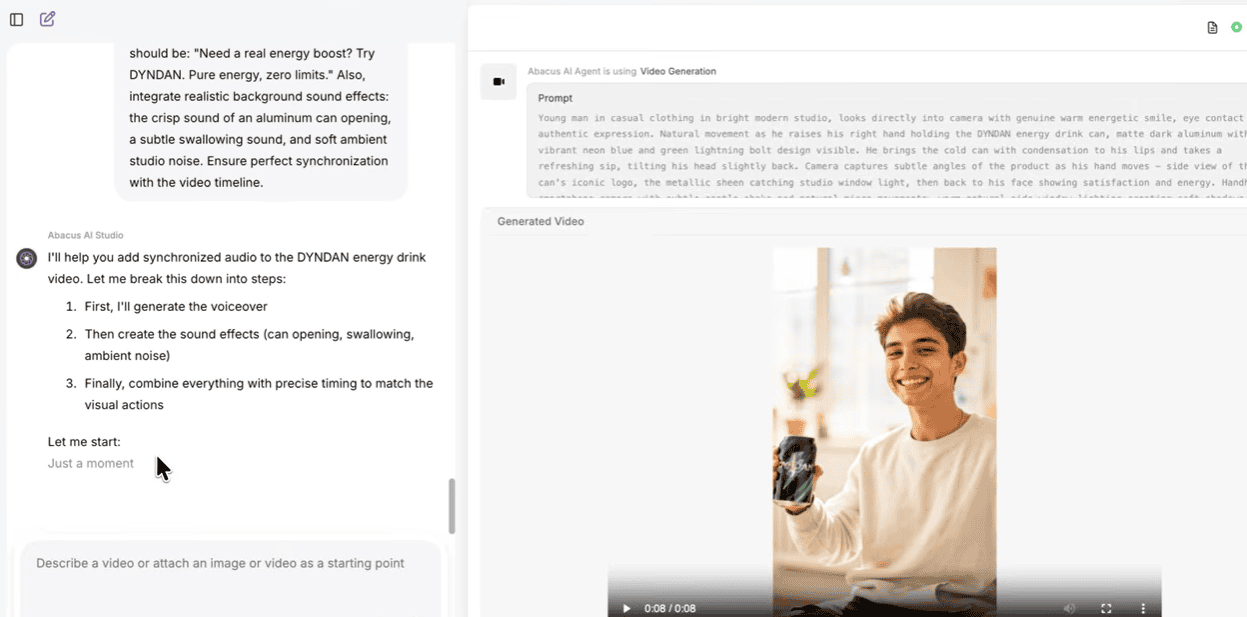
Abacus AI Studio is the creative layer of the platform — a chat-style workspace for generating, editing, and enhancing images and videos without jumping between separate tools.
Image models available: GPT Image 1.5, GPT Image 2, Nano Banana 2, Nano Banana Pro, Seedream 4.5, Midjourney, Grok Imagine Image, FLUX.2 Pro, Hunyuan Image 3.0, Wan 2.7, Imagen 4, Recraft SVG, Ideogram 3.0, Magnific Upscaler, and editing models (GPT Image Edit, Qwen Image Edit).
Video models available: Sora 2, Seedance 2.0, Wan 2.5, Seedance 1.5 Pro, Hailuo 2, Kling AI v3, Kling AI O3, Kling v2.6 Motion Control, Luma Labs, Veo 3.1, Veo 3.1 Lite, Grok Imagine Video, Topaz Upscaler.
Speech models: ElevenLabs, OpenAI, Hume (Text-to-Speech, Speech-to-Text, Speech-to-Speech.
Key capabilities worth knowing:
- Auto Mode: Describes what you want and the system picks the best model and settings automatically — useful when you don't want to manually configure every generation.
- Image-to-Image editing: Upload an existing image, describe your changes, the model applies them while preserving what you didn't ask to change.
- Image-to-Video: Animate a still image with a text prompt.
- Motion Control: Upload a reference image or video to guide the motion profile of generated video (powered by Kling v2.6).
- Lip-sync: Upload a portrait, type your script, the model generates synchronized speech and facial animation.
- Upscaling: Magnific Upscaler supports up to 16x upscaling for images across 9 style presets; Topaz Upscaler handles video at 2x/4x.
- Vector SVG output: Recraft SVG generates true scalable vector files — useful for logos, icons, and design assets that need to scale without quality loss.
- Workflow chaining: Run image → upscale → animate → upscale video, all within one conversational session.
Pricing within Studio uses a credit system. Credit consumption varies by model, resolution, and duration. Higher resolutions and longer videos use more credits. The billing dashboard shows real-time balance and usage history.
Abacus AI SuperComputer — Cloud Infrastructure for AI Projects
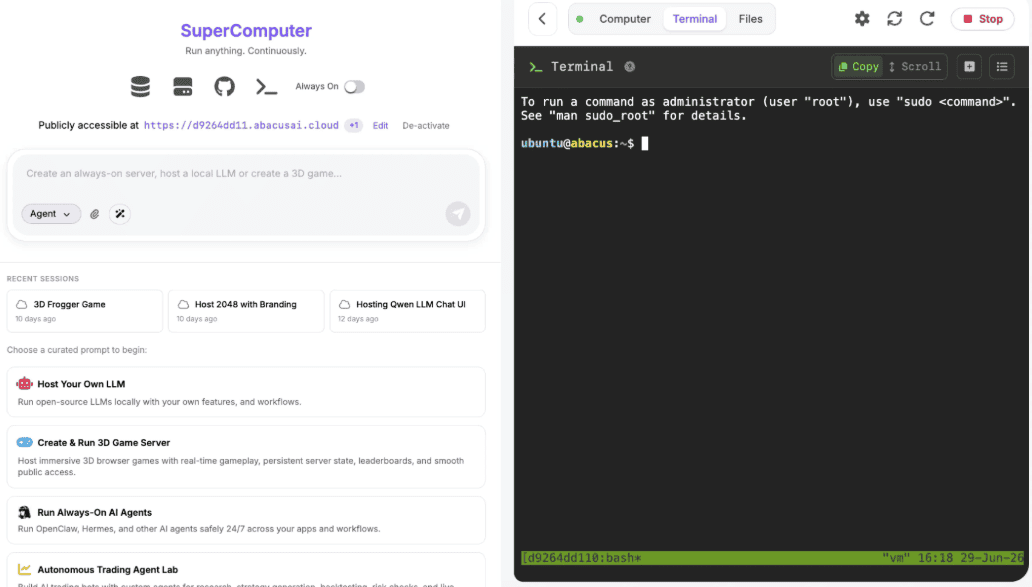
Abacus AI SuperComputer is the infrastructure product — a persistent, always-on cloud environment for users who need to build, deploy, and host AI projects continuously.
The analogy Abacus AI uses is AWS-like infrastructure without the infrastructure management overhead. That's reasonably accurate. You get a full Linux environment (Ubuntu), terminal access with root permissions, databases, S3-style storage, SSH connectivity, inbound HTTPS, and GitHub integration — all managed for you.
Technical specifications:
- 2 vCPU, 8 GB RAM, persistent disk storage.
- Terminal access with root permissions.
- PostgreSQL and other database support.
- S3-style cloud storage for files, datasets, and assets.
- SSH access for connecting from your own tools and editors.
- Inbound HTTPS for hosting web services at a public URL.
- GitHub integration for bringing in existing repositories.
What people use it for:
- Hosting a custom LLM assistant with their own prompt, data, and UI.
- Building and hosting apps, dashboards, backend services, and APIs in any tech stack.
- Running scheduled cron jobs and long-running automation that needs to persist between sessions.
- Hosting open-source applications from their own repositories.
- Machine learning workloads with TensorFlow, PyTorch, or scikit-learn.
How it differs from Abacus AI Agent: The Agent is a general intelligence layer that helps you complete tasks. SuperComputer is the persistent infrastructure to build, host, and run anything continuously. One is about task execution; the other is about always-on hosting and compute.
Abacus AI Role Play — Create, Customize, and Roleplay With AI Characters
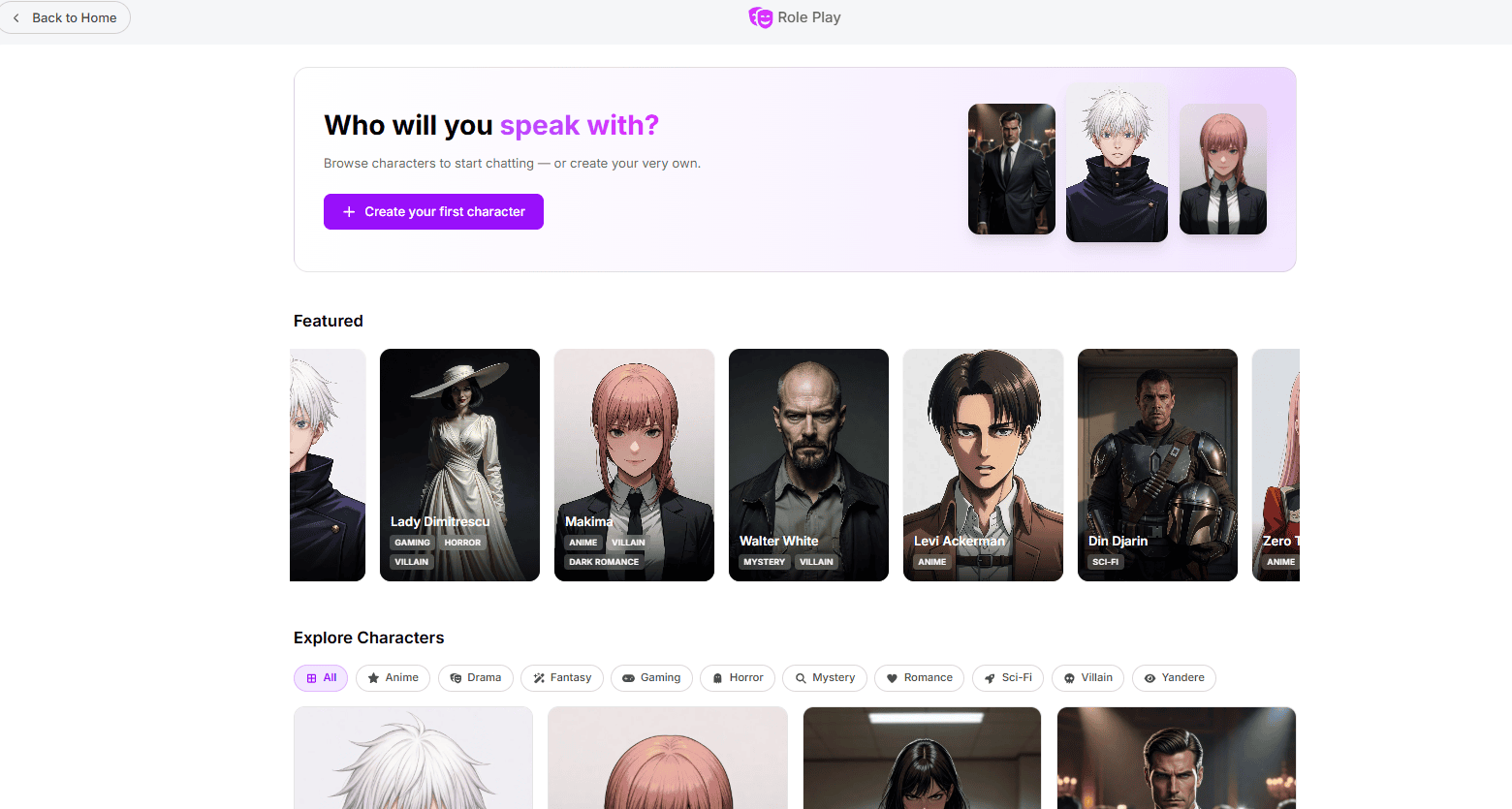
Abacus AI Role Play represents a more recent addition to the Abacus platform, taking the capabilities of ChatLLM beyond simple conversation by enabling users to create AI characters with certain personae, histories, and behaviors to engage in prolonged conversations as those characters.
The Role Play application is far more flexible than might seem at first glance:
- For training and simulations purposes: sales teams can train on handling objections with the help of prospect personas built using AI technology; interviewers can prepare for talking with their candidates; support teams can handle tough customer scenarios.
- For language training: practicing conversations in a more immersive way by using consistent AI characters.
- For content writing: writers create dialogues between AI characters or test out their ideas for storylines.
- Education and onboarding: using scenario-based approach where users have conversations with the persona of a customer, co-worker, stakeholder, etc.
Personas are highly customizable: tone, knowledge domain, personality traits, and conversational constraints are just some of them. Role Play memory ensures that the conversation has a logical flow as characters can refer back to what was discussed before.
Abacus AI Enterprise
The Enterprise edition is a different product category altogether from the consumer and team editions – one built for businesses that require AI infrastructure rather than AI capability.
Key components of Enterprise include:
Full MLOps platform:
- Comprehensive workflows from data ingestion through training, deployment, and monitoring of models.
- Real-time data processing and stream.
- Custom Large Language Model training and finetuning using proprietary data.
- Automatic retraining of models based on data drift.
- Monitoring of models’ performance and anomaly detection.
AI everywhere in the enterprise:
- Enterprise-grade AI super-assistant for every employee.
- Fully capable in chat, code, voice, image, and video.
- Integration with existing internal systems and data sources.
- Single sign-on, role-based access controls, complete audit trail.
AI specialization:
- Forecasting and demand prediction.
- Anomaly detection through operational data.
- Customer-facing personalization engine.
- Fraud detection and risk scoring.
- Vision AI for image classification and processing.
- Language AI: NLP pipeline, sentiment analysis, Q&A system on internal data.
- Discrete optimization: scheduling, resource allocation, supply chain planning.
Industry applications: Enterprise customers include retail (personalization, demand prediction), finance (fraud detection, risk management), health and manufacturing industries (operations optimization), marketing and sales (lead scoring, revenue prediction), and IoT (device monitoring and failure prediction).
Regulatory compliance: GDPR, SOC-2 Type 2, HIPAA, private model deployment, role-based access control, and audit logging. Enterprise customers get dedicated support and custom SLAs.
Abacus AI Pricing: Complete Breakdown
Abacus AI uses a tiered subscription model. Here's how pricing currently breaks down:
| Plan |
Price |
Core Inclusions |
| Basic |
\$10/user/month |
ChatLLM Teams, limited Abacus AI Agent access with three conversations and 2,500 credits per conversation, AppLLM, RouteLLM API, limited Abacus AI Desktop, and limited CoWork access. |
| Pro |
\$20/user/month |
Everything in the Basic plan, plus unrestricted Abacus AI Agent access, Personal AI Agents including Claw and Hermes, full Abacus AI Desktop and CoWork access, and 30,000 credits per month. |
| Enterprise |
Custom pricing |
Full MLOps stack, custom model training, dedicated support, advanced compliance features, and private model deployments. |
Regarding credits: Credits are used up when using compute-heavy tasks such as video generation, image generation using high-quality models, agent runs with complicated requirements, and hosting Personal AI Agent. Unlimited text-based chats do not use up credits. The Pro plan comes with 30,000 credits per month, and extra credits can be bought from the dashboard. You can also provide your own API keys and save up credits for using models.
Abacus AI vs ChatGPT: Honest Comparison
The "Abacus AI vs ChatGPT" comparison is one of the most common questions people have — and it's worth answering carefully, because they're not really competing for the same user.
| Feature |
Abacus AI (ChatLLM Pro) |
ChatGPT Plus |
| Monthly price |
\$20/month for Pro or \$10/month for Basic |
\$20/month |
| Model access |
100+ models, including GPT, Claude, Gemini, Grok, DeepSeek, Qwen, and other open-source models |
OpenAI models only |
| Autonomous agents |
Yes, including Abacus AI Agent, Claw, and Hermes |
Limited |
| App building and deployment |
Yes, with full-stack application deployment |
No |
| Always-on background agents |
Yes, Claw and Hermes can run continuously |
No |
| Team collaboration |
Unlimited members, shared projects, and shared chats |
Limited |
| Enterprise integrations |
Slack, Google Drive, Jira, Confluence, Microsoft Teams, and Gmail |
Limited |
| Coding environment |
Abacus AI Desktop with CLI, Code Editor, and CoWork modes |
Code execution and coding tools |
| Image generation |
Access to 10+ image models |
OpenAI image-generation models |
| Video generation |
Access to 12+ video models through Abacus AI Studio |
Limited availability |
| Self-evolving agents |
Yes, through Hermes |
No |
| Data privacy |
SOC 2 Type II, HIPAA compliance, and no training on customer data |
SOC 2 controls and no training on eligible customer data |
| Best for |
Power users, developers, teams, and businesses |
Casual to moderate OpenAI users |
In a nutshell: ChatGPT Plus is the winner in case you use mostly OpenAI models, like a user-friendly design, and don’t require any agents, application deployment, or multi-model integration. In case you seek for more – multiple models, higher levels of automation, application deployment, agents that work without your direct participation, go with Abacus AI. The \$10 Basic pricing plan is more cost-effective than ChatGPT Plus for all cases. Pro plan for \$20 offers features that ChatGPT does not have at all.
Is Abacus AI Safe?
Privacy and safety can be genuine concerns while using any AI-powered product or application. If the product integrates itself with your emails, docs, calendars, and other business applications, then these concerns become even more valid.
The following has been independently validated by Abacus AI:
- Compliance with SOC-2 Type 2 certification standards: This implies that the security controls used by Abacus AI are independently audited and not self-certified. SOC-2 Type 2 is considered one of the most trustworthy and authentic certifications for software products.
- Compliance with HIPAA standards: The platform complies with HIPAA guidelines and standards for security and privacy of healthcare-related information.
- Encryption: All chats, agent configurations, uploads and context data are encrypted while in transit and at rest.
- No training on your data: Abacus AI does not train its models on your chat logs, documents, or agent interactions. All your data belongs to you.
- Data deletion upon request: You can delete all your data upon request. It is account-specific and is deleted completely.
- Enterprise Controls: Enterprise users have access to role-based access controls, audit logs, and model deployment in private mode.
Most professional use cases (sensitive documents, customer data, compliance industries) will find that Abacus AI provides a strong security framework. Those with industry-specific compliance needs should consult the enterprise compliance documents.
Abacus AI Strengths and Limitations: What Works and What Needs Improvement
No platform does everything perfectly. After thorough analysis of the product and user feedback across multiple communities, here's an honest breakdown:
What Works Well
- Exceptional model consolidation. Having GPT-5.5, Claude Opus 4.8, Gemini 3.1 Pro, and Grok 4.3 in a single workspace with automatic routing is genuinely useful. Most users don't need to think about which model to use — RouteLLM handles it.
- Abacus AI Agent is a real product. Skepticism about "AI agents" is warranted after years of overpromising in the industry. Abacus AI Agent is different: it deploys functional, hosted applications, completes multi-step research with real sources, and executes workflows through actual integrations. It makes mistakes — all agents do — but the failure mode is "needs iteration," not "produces nothing useful."
- The value at \$10/month is hard to argue with. This is perhaps the most consistent point of agreement among users across review platforms. For anyone currently paying for multiple AI subscriptions, the consolidation value is immediate.
- Hermes is genuinely innovative. The concept of an agent that builds persistent skills over time and improves at your specific workflows is not just a marketing claim — it's an architectural choice reflected in how Hermes stores and applies learned strategies. This matters for repeat, complex workflows.
- Studio's breadth of creative models. Having Sora 2, Veo 3.1, Midjourney, and FLUX.2 Pro in one workspace, with workflow chaining (image → upscale → video), is a practical time-saver for content teams.
What Could Be Improved
- The credit system may come as a surprise to you. The most frequent complaint of users about the credit system is that credits go away faster than anticipated, particularly in generating videos, premium image models, and running agents. The pricing plan for additional credits (\$10 per 10,000 credits) should be more prominent during account creation.
- The interface is dense. Coming from an easy-to-use chat interface such as Claude.ai, ChatLLM has too much going on, which may seem confusing at first. There are a lot of features that are available through the sidebar, but figuring out where everything is will take some time.
- Agents may run inconsistently. Agents tend to hallucinate, take unexpected directions, or even generate outputs that require substantial editing afterwards. Do not consider that the agent outputs a completed work when executing important and irreversible actions.
- Support response times vary. In some cases, support requests related to billing and other concerns have been reported to take longer than expected. You may want to consider this if you need quick and consistent support.
- CoWork and other features work on Desktop only. Some of the most powerful features like Listener, CoWork, and CLI mode need you to download the desktop version of the application.
Who Should Use Abacus AI—and Who Might Want to Look Elsewhere?
A strong fit for:
- Developers and engineers who want a single subscription covering AI chat, a top-tier coding agent, GitHub integration, and CLI tools — without managing separate subscriptions for each.
- Startup founders and indie builders who need to move from idea to deployed application quickly. Vibe coding through Abacus AI Agent is genuinely faster than traditional development for prototyping.
- Analysts and researchers who work with documents, datasets, and need to synthesize information from multiple sources. ChatLLM's document analysis combined with the agent's research capabilities makes a strong combination.
- Content and creative teams using multiple AI tools for images, video, and writing. Studio consolidates 25+ creative models into one workspace, which reduces both cost and context-switching.
- Businesses automating repetitive workflows — invoice processing, CRM updates, lead research, reporting — that currently require human time or cobbled-together integrations.
- Teams currently paying for 3+ AI subscriptions. The math is simple: \$10/month for everything Abacus AI includes almost always costs less than maintaining separate tools.
Might want to look elsewhere:
- Small-time AI chatters. In case you require a very basic usage of AI, perhaps a few times a week, free versions of ChatGPT and Claude would be more than enough for you. Abacus AI's intricacy can be considered a drawback in such cases.
- The complete newcomers to AI. The initial setup expects certain experience in AI applications. You can start with some consumer-level products if you have never worked with AI before.
- Academics and research labs that require full access to GPUs. Abacus AI maintains its own infrastructure for you, which is a great thing for most people, but might be a drawback for those scientists that need to manage their computing.
- Teams require instant help all the time. If your business depends greatly on the service and you need the highest level of SLA and instant human response, think twice before choosing the enterprise version.
Frequently Asked Questions About Abacus AI
What is Abacus AI and what is included?
Abacus AI is an AI suite including access to over 100 top AI models (GPT-5.5, Claude Opus 4.8, Gemini 3.1 Pro, Grok 4.3, DeepSeek and many others), autonomous AI agents (Abacus AI Agent, Claw, Hermes), code editor and execution environment (Desktop with CLI, Code Editor, Listener, CoWork), creative software (Studio with over 25 image and video models), app building in the browser-based AppLLM, API router called RouteLLM, and cloud hosting services for AI (SuperComputer) — all within a single subscription beginning at \$10 per month.
Is Abacus AI a ChatGPT alternative?
It could be, but it would be more correct to say that it is not only an alternative, but actually a replacement plus more. ChatLLM gives access to OpenAI models and provides everything ChatGPT gives — plus Claude, Gemini, Grok, open source models, autonomous agents, app deployment, always-on agents, video generation, and teamwork capabilities. For those currently using ChatGPT Plus for \$20/month and up, it means that switching to Abacus AI basic plan will provide cost savings and added capabilities. At the same time, if you use only OpenAI models and prefer simplicity, ChatGPT may suit you better.
Is Abacus AI worth the money?
For power users and teams: almost certainly yes. The consolidation value alone — replacing multiple $20/month AI subscriptions with one \$10/month subscription — covers the cost many times over. The autonomous agent capabilities (building apps, automating workflows, always-on agents) add significant productivity value that competing platforms at similar price points don't offer. The main caveat is that heavy users of video generation or complex agent tasks need to budget for credit top-ups, which can add to the monthly cost.
How do Abacus AI credits work?
Credits are the consumption unit for compute-intensive tasks. Standard text-based chat with AI models does not deplete credits on the unlimited plan. Credits are consumed by: video generation, image generation with premium models, complex multi-step agent runs, Personal AI Agent hosting (Claw costs 1 credit per 5 minutes of active hosting), and large document processing. The Pro plan includes 30,000 credits/month. Additional credits can be purchased from the billing dashboard when needed. You can also connect your own API keys to bypass credit usage for model calls if you prefer direct billing from providers.
Is Abacus AI suitable for businesses?
Absolutely – for small teams and for enterprises. For small teams, ChatLLM allows unlimited users, shared projects, enterprise integration with Slack, Google Drive, Jira, Confluence, Teams, Gmail, role-based access. SOC-2 Type 2 and HIPAA compliant. For enterprises, Abacus AI provides the whole infrastructure for MLOps – customized model training, live data pipelines, models monitoring, forecasting engines, fraud detection. Used by 6,000+ enterprises and Fortune 500 businesses. Enterprise pricing is custom.
What is the cost of using Abacus AI?
- Basic plan – \$10/user/month – ChatLLM, restricted AI Agent, AppLLM, RouteLLM API.
- Pro plan – \$20/user/month – all features from basic plan plus unlimited AI Agent, Personal AI Agents (Claw + Hermes), full Desktop and CoWork access, 30,000 credits/month.
- Enterprise pricing – Custom.
Final Verdict: Is Abacus AI Worth It?
After examining every layer of the platform — the models, the agents, the creative tools, the developer environment, the infrastructure, the pricing, and the real-world user feedback — the honest answer is: yes, for most of the people who would consider it.
The \$10/month basic plan is a straightforward win. You get access to every major AI model, document and data analysis, image generation, web search, a code playground, and team collaboration. That alone is more than what most competing single-model subscriptions offer at twice the price. If you're currently paying for multiple AI tools, the consolidation math works in your favor immediately.
The \$20/month Pro plan is where the platform becomes genuinely differentiated. Abacus AI Agent building and deploying functional full-stack applications from a plain English description isn't just a party trick — it's a real productivity capability that founders, developers, and product teams can use. Abacus Claw and Hermes running 24/7, maintaining memory, and improving over time represent a different model of AI assistance than anything else at this price point.
However, there are several issues with the service. The credit system could have been more transparent, and power users, especially in terms of video generation and agentic tasks, will face challenges. There is a bit of a learning curve for the interface, the support could be more responsive, and sometimes complicated agent runs require iterations for successful results.
But that's how the bigger picture looks like: Abacus AI is developing something that not many other AI platforms develop — an ecosystem where the chat layer, agent layer, creative layer, developer layer, and infrastructure layer are actually connected. At a time when most platforms are offering single-purposed products, such an integration has its value.
Abacus AI would be useful for any developers, founders, analysts, and teams that are heavily using AI and need more than text generation. It would not be suitable for casual users who just need a chatbot for their website or something else simple.
Rating: 9/10
 Instagram Engineering
 Shopify Engineering