 Pirate sites and services can be a real challenge for rightsholders to deal with. In India, however, recent court orders have proven to be quite effective.
Indian courts have issued pirate site blocking orders for over a decade. Initially, these orders were relatively basic, requiring local Internet providers to block specific domain names. However, these early orders have evolved quite a bit since then.
In 2023, several Hollywood studios obtained a seminal court order that significantly expanded the scope. In addition to requesting Indian Internet providers to block pirate sites, it also required domain registrars to “lock and suspend” the domain names while sharing registrant data with the rightsholders.
This broad Delhi court order became a new standard going forward. American rightsholders used it against a wide variety of pirate sites and, through this Indian route, they targeted American domain registrars such as Namecheap and Porkbun. Effectively, the Delhi High Court now has the power to take domains offline worldwide.
U.S. Rightsholders Praise Indian Model
Thus far, U.S. rightsholders have not commented in great detail on these Indian efforts. However, the International Intellectual Property Alliance (IIPA), which represents the interests of prominent rightsholder groups, including the MPA and RIAA, recently highlighted it.
IIPA makes its remarks in its annual “Special 301” recommendation to the U.S. Trade Representative (USTR). This inquiry allows rightsholders to flag shortcomings and concerns in foreign countries.
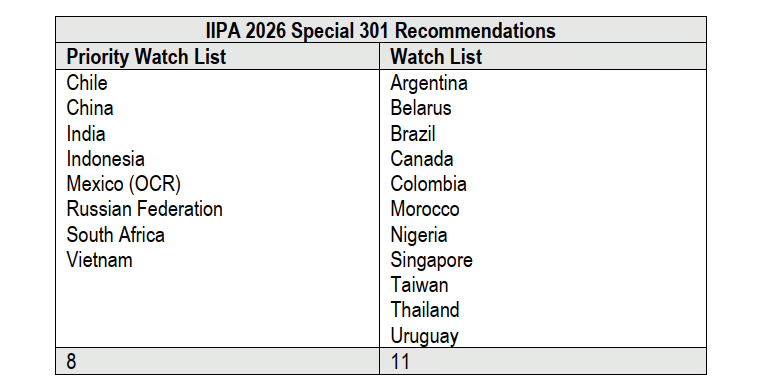
The IIPA traditionally sees India as a problematic country, and this year it also recommends the USTR put it on the Priority Watch List. However, there is praise too, especially for the site-blocking efforts.
The “lock and suspend” orders, in particular, have helped to (temporarily) take out hundreds of pirate sites. This includes targets such as Animeflix, Vegamovies Fmovies, SFlix, VidSrc, and many others.
“To date, more than 400 piracy domains have been completely wiped from the Internet, representing billions of global piracy visits,” IIPA writes.
“Rights holders are encouraged by the Delhi High Court’s progressive understanding of the technologies involved in modern digital piracy and its resolve to grant creative relief to truly tackle piracy on a global scale.”
Effective Disruption
IIPA notes that these court orders are “unusually disruptive for pirate operators”. This is in part because they target domain names through U.S. domain registrars. This means that the impact of these court orders is felt globally.
Also, since the domain registrars are required to share the personal details of the domain registrants, these orders can help with follow-up enforcement actions.
These Delhi High Court orders have helped to tackle movie and TV-show piracy, and IIPA suggests that this is also showing in the numbers. Anime and manga are now the dominant piracy categories, with less than 30% of the top pirate sites (ex. music) focused on U.S. movies and TV content.
“This can be said to be at least in part attributable to the consistent orders being made by the Delhi High Court to disable access to all the top pirate film, TV, and streaming sites,” IIPA writes.
Additionally, IIPA highlights enforcement achievements by the local authorities. For example, the high-profile action against the alleged operator of the streaming platform iBomma, who was arrested soon after he landed at Hyderabad Airport.
More Can Be Done
Of course, IIPA’s report isn’t just a summary of positive notes. After all, the group lists India as a high-priority threat, so there is plenty of room for improvement.
“While these promising developments raise hopes that concerted actions can have a positive impact to disrupt the piracy ecosystem, more needs to be done to ensure deterrence becomes the norm to drive would-be pirates from these damaging activities,” IIPA writes.
For example, IIPA complains that some Indian Internet Service Providers (ISPs) are slow to implement the blocking orders passed by the Delhi High Court and calls for tighter timelines.
In addition, not all foreign domain name registrars are complying with the Indian court orders. This means that the global reach of these orders remains limited.
Finally, since broad blocking orders are limited to the Delhi Court, rightsholders recommend replicating these state-level blocking successes nationally across all Indian states.
The site-blocking recommendations are just the tip of the iceberg, however. The IIPA recommends India to undertake a long list of actions, ranging from taking action against illegal camcording in movie theaters to improving the proposed Digital India Act by adding anti-piracy measures.
IIPA’s suggested priority actions for India
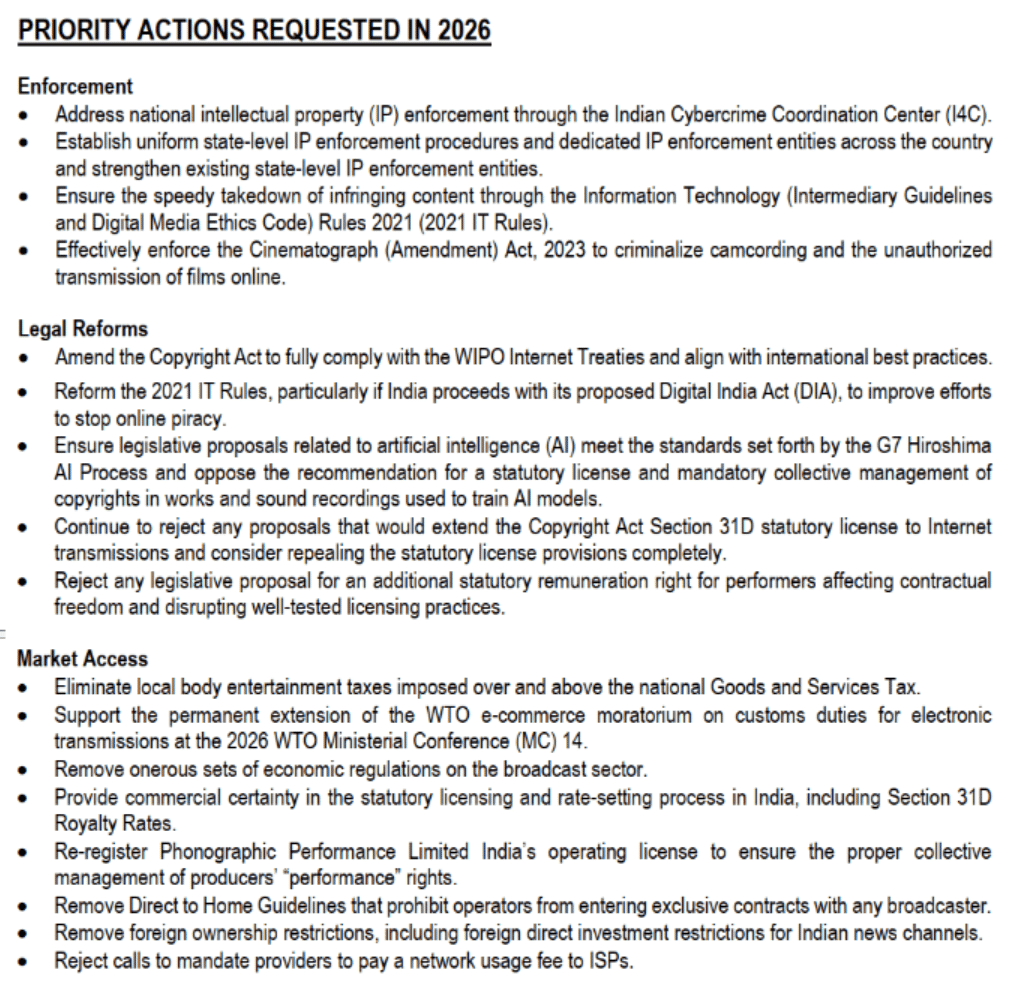
IIPA’s conclusion is that India deserves to be called out on the USTR’s “Priority Watch List” in the upcoming Special 301 Review. Whether the U.S. government agrees has yet to be seen, but it wouldn’t be a surprise, as India has consistently been marked as a priority threat in recent years.
—
IIPA’s 2026 Special 301 Report on Copyright Protection and Enforcement, which includes all India references, is available here (pdf).
 Instagram Engineering
 Shopify Engineering