 For years, record labels sued U.S. Internet providers that kept serving subscribers who were repeatedly accused of piracy.
This strategy took a major hit in March, when the Supreme Court wiped out the $1 billion verdict against Cox.
According to the Court, knowing about piracy and failing to act on it is not enough to make an ISP liable for contributing to it. However, south of the border, lawmakers have now taken a different approach.
On Tuesday, Mexico’s Senate approved a reform of the Federal Copyright Law that ties ISP liability to having a policy to terminate repeat infringers.
Senate Backs ISP Liability Rules
The Senate approved the amendments with roughly two-thirds of the vote, as the opposition voted against.
The Chamber of Deputies already approved the same text in October, so the decree now goes to President Claudia Sheinbaum. Her government proposed the changes in May to bring the law in line with the USMCA trade agreement between Mexico, the United States and Canada.
U.S. rightsholders pushed Mexico for ISP liability rules as well. In January, copyright industry coalition IIPA complained that Mexico’s 2020 reform “did not provide a clear principle of secondary liability for those inducing or promoting copyright infringement.”
In April, the USTR moved Mexico to a lower tier of its piracy watch list, citing the draft amendments.
Disconnect Repeat Infringers
The trade agreement also prompted an earlier change in 2020, when Mexico added DMCA-style safe harbors to its copyright law. As a result, hosting platforms and search engines are only protected if they have a policy to terminate the accounts of repeat infringers, but this didn’t apply to regular consumer ISPs.
The new amendments change that, requiring Internet providers to have a policy for terminating the service of repeat infringers. This policy has to be published permanently on their website and in their terms of service, and it must include a basic way to notify users.
New condition for Internet providers
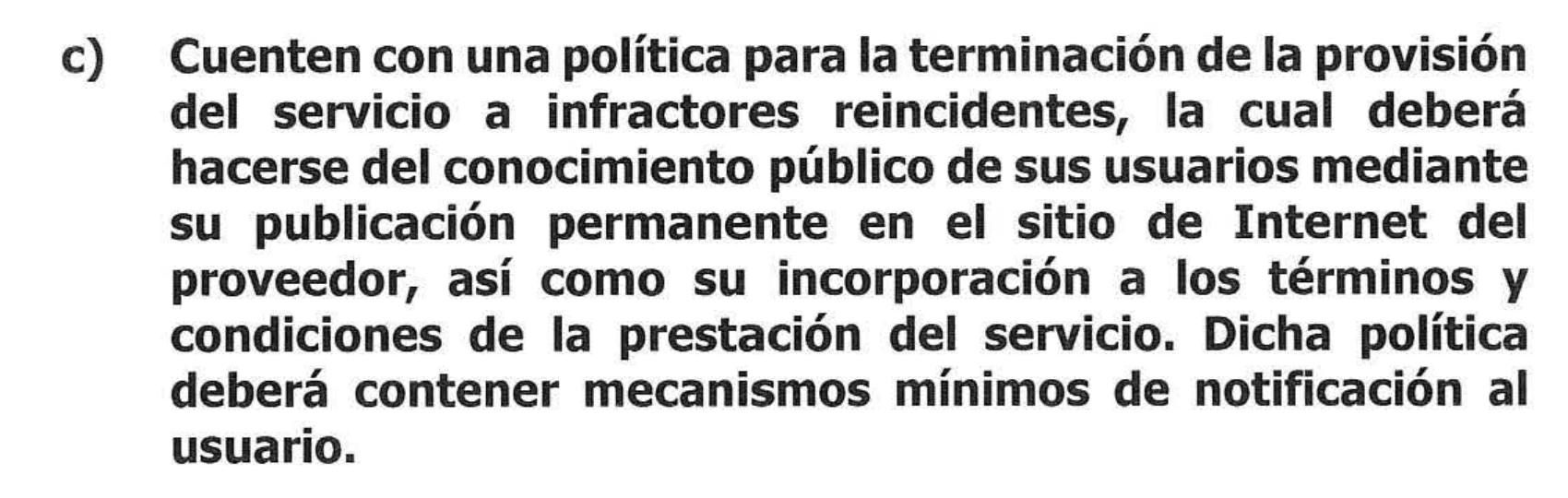
In other words, what can be terminated is the Internet connection itself, not just an account. According to Mexican business outlet EL CEO, this means that access providers such as Telmex and Izzi will need such a policy.
Providers that don’t comply risk facing liability.
Under the new rules, any ISP that fails to meet its safe harbor conditions becomes liable for its users’ infringements if it knowingly contributes to, induces, or causes the infringement.
The same goes for an ISP that can control the infringing user and profits directly from the infringement. In both cases, the Mexican Institute of Industrial Property (IMPI) can fine the provider up to roughly 4.7 million pesos (~$250,000), depending on the infringement.
Who Is a Repeat Infringer?
The law doesn’t explicitly define the term repeat infringer, nor does it say how many piracy accusations it takes before a subscriber can be cut off.
According to Aurora López-Portillo, director of legal services at IP firm ClarkeModet, each provider has to decide its own threshold. She told EL CEO that ISPs should also check whether the accusations actually hold up, while giving users a chance to respond, even though the law doesn’t require that.
During Tuesday’s Senate debate, some lawmakers in the opposition raised similar concerns. Senator Gabriel Elizondo warned that families can share a single connection, so the pirating activities of one person could leave an entire household offline.
Previously, opposition lawmakers proposed requiring a court order before Internet service could be suspended, but that proposal was not adopted.
Not Like Cox
In the U.S., the DMCA has a similar requirement too. ISPs that want safe harbor protection must implement a policy to terminate repeat infringers in appropriate circumstances. However, as the Supreme Court pointed out in the Cox case earlier this year, failing to meet that requirement doesn’t count against an ISP that argues it didn’t infringe.
“Under our precedents, a company is not liable as a copyright infringer for merely providing a service to the general public with knowledge that it will be used by some to infringe copyrights,” Justice Thomas wrote in the Court’s opinion.
Not liable

Mexico’s law uses a different route.
There, failing to meet the safe harbor conditions, including the repeat infringer policy, is the first requirement for liability. If an ISP also contributes to infringement with knowledge of it, or can control the infringer and directly profits from it, it can be held responsible.
The new repeat infringer rules will take effect 180 days after their publication in Mexico’s official gazette, which hasn’t happened yet as far as we can see. How Mexican ISPs will define a repeat infringer, and how many accusations it takes, has yet to be seen.
—
A copy of the amendments approved by Mexico’s Congress is available here (pdf, Spanish). The U.S. Supreme Court’s opinion in Cox v. Sony can be found here (pdf).
 Instagram Engineering
 Shopify Engineering