British pubs are disappearing at an alarming rate. Last year around eight closed down every week.
And it’s not simply because people are drinking less. The crisis has been caused by the economics of running a pub.
Our latest research suggests that Britain’s pub’s are suffering from rising costs, large debts and the changing priorities of large pub-owning companies.
Of course, the market changes. Younger people are drinking less, online socialising has expanded and supermarkets can sell alcohol at prices that pubs cannot hope to match.
But it is too easy to dismiss so many pub closures as the inevitable consequence of changing tastes. To do so would be to ignore the political choices and financial structures which are making things worse.
We found, for example, that one of the biggest problems has been the rise of large pub companies (known as “pubcos”) since the 1990s.
These firms used a business model in which owning pubs became increasingly detached from brewing beer. Large estates were assembled using substantial borrowing, with the buildings and their future cash flows underpinning the debt.
That model looked attractive when interest rates were low and property values were rising. But it became much more fragile when borrowing costs rose, energy bills soared and customers had less money to spend.
In those circumstances, the pressure to service debt can take priority over a pub’s survival.
The problem is not that every large pub company is badly run, or that debt is inherently wrong. The problem is that a financial model built around property portfolios and debt can create incentives that conflict with the interests of tenants and communities.
It means that a pub can be worth more dead than alive.
The location and land may offer a developer a profitable opportunity to build houses for example. The owner therefore has a financial incentive to sell, even where the business might remain viable.
But the market price of a building does not capture its value to the community.
And where a developer sees a housing opportunity, local residents may simply see the loss of their last meeting place. Once that pub has been converted into flats, the social asset is gone. No amount of nostalgic speeches about British pub culture will bring it back.
Because pubs are not simply businesses selling pints. They are part of the social infrastructure that holds communities together. When the last pub in a village closes, residents lose far more than another place to drink. They lose a place to meet, talk, make friends, support local causes and feel part of a community.
Time at the bar
A pub is what social scientists call a “third place”: somewhere beyond home and work where people meet on relatively equal terms. It can host a darts team, a charity fundraiser, a book club meeting or simply the regular who comes in for a chat.
For people living alone, older residents and those at risk of isolation, that ordinary interaction can matter enormously. A pub can also act as a warm space in winter or provide a base for community activities.
These benefits rarely appear on a company’s balance sheet, but they are real.
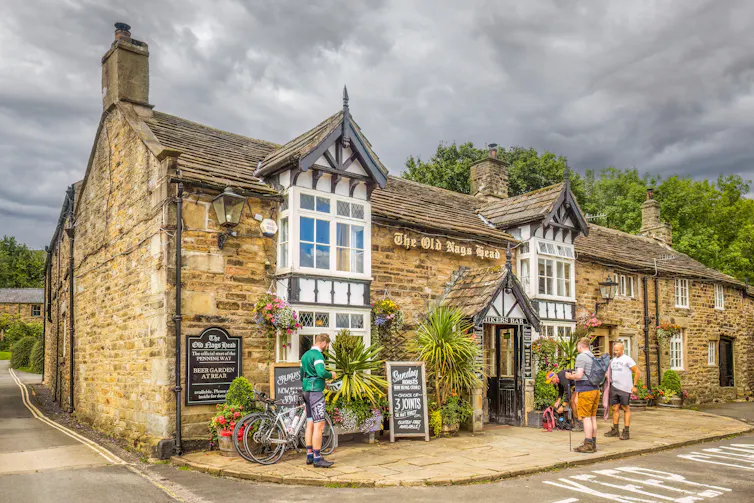
Community asset. Pete Stuart/Shutterstock
Here lies the central policy contradiction. Governments routinely celebrate pubs as community hubs, contributors to tourism and anchors of high streets. Yet the tax and regulatory system too often treats them as convenient sources of revenue from alcohol and immovable commercial property.
Business rates have been a particular problem. The latest budget did raise the small business rates threshold offering pubs some relief. But they still face substantial fixed costs regardless of how well they are trading.
Rising wages, national insurance costs, energy bills and alcohol duty add further pressure. Supermarkets, meanwhile, can sell alcohol cheaply and shift much of their business online or into large distribution networks. The result is a playing field that is far from level.
None of this means pubs should receive unlimited public subsidy. Nor should every struggling pub be preserved regardless of whether it has customers or a viable future. But government needs to distinguish between an un-viable business and a valuable community asset being undermined by an unfair cost structure or a speculative property sale.
Britain’s pubs are not just businesses, they are part of the country’s social infrastructure. It is time they were treated that way, before too many more call last orders for the last time.
 Instagram Engineering
 Shopify Engineering