When a ship sinks, it is often in tragic circumstances. Beneath the waves, however, a different story unfolds: shipwrecks become the foundations of new life.
Rusting hulls, broken masts and even piles of wartime munitions can, through time, be transformed into rich ecosystems. Scientists call this “shipwreck ecology”, and it offers a fascinating lens through which to view both the adaptability of marine life and the unexpected ways human shape the seascape.
This is illustrated vividly by a recent scientific study of a second world war munitions dump in the Baltic Sea near Germany. What many would see as hazardous waste has, over the decades, become home to diverse communities of mussels, crustaceans, fish and plant life. Even corroding shells and explosives are now teeming with life.
Although leaking toxic compounds can be risky, the site demonstrates how marine organisms repurpose human-made structures into thriving habitats.
The ecological transformation of a shipwreck begins almost immediately after it settles on the seabed. Metal, wood or concrete provide rare hard surfaces in otherwise sandy or muddy seafloors.
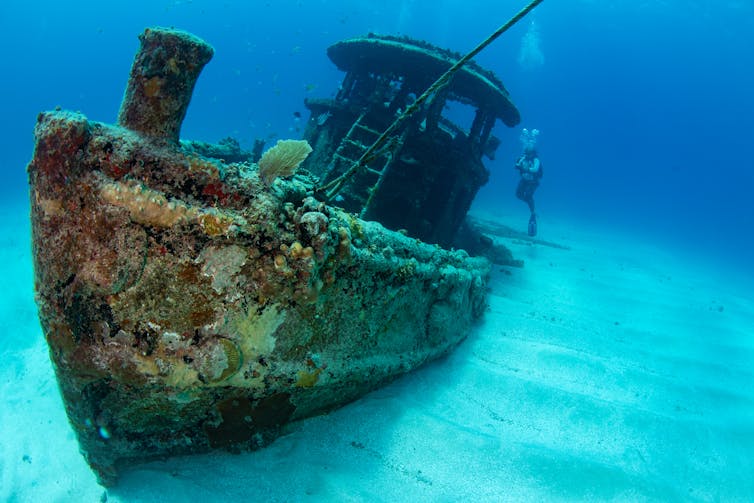
Marine microscopic algae, bacteria and fungi are the first colonisers, forming slimy biofilms within days. These in turn attract barnacles, tube worms and sponges, followed by larger organisms such as soft corals, sea fans and crustaceans.
[
](https://images.theconversation.com/files/708119/original/file-20251211-56-81xli5.jpg?ixlib=rb-4.1.0&q=45&auto=format&w=1000&fit=clip)
A coral-covered island, surrounded by barren sand. timsimages.uk / shutterstock
As complexity increases, wrecks begin to function like artificial reefs. Nooks and crannies provide refuge for small fish, which attract larger predators. Over time, wrecks become islands of life in relatively barren seascapes, often rivalling natural reefs in their biodiversity.
Shipwreck nations
The British Isles might be Europe’s shipwreck capital – their waters are littered with an estimated 40,000 wrecks, with each telling its own ecological story. As a marine ecologist and licensed scuba dive instructor, I’ve been able to explore merchant ships, warships and fishing vessels, all slowly becoming habitats in their own right.
Some of the most famous include the Scapa Flow wrecks in Orkney, off the north coast of mainland Scotland, where a scuttled German fleet from the first world war has become both a mecca for divers and a haven for marine life. Their steel hulls are now draped in colourful soft corals, while pollock, wrasse and conger eels patrol the shadows.
Off Dorset in southern England lies the Aeolian Sky, a cargo ship that sank in 1979. Its twisted structures now support shoals of bib or pout fish (a small relative of cod), while lobsters and edible crabs shelter in its cavities.
Nearby, the Kyarra, sunk in 1918, is decorated with jewel anemones and sponges. There’s also the HMS M2, a submarine aircraft carrier wrecked in 1932 and now cloaked in plumose and jewel anemones, hydroids and sponges. Shoals of bib and pollock circle the submarine, while wrasse, gobies and seasonal cuttlefish use the hull for breeding.
[
](https://images.theconversation.com/files/708117/original/file-20251211-62-tgf4v2.jpg?ixlib=rb-4.1.0&q=45&auto=format&w=1000&fit=clip)
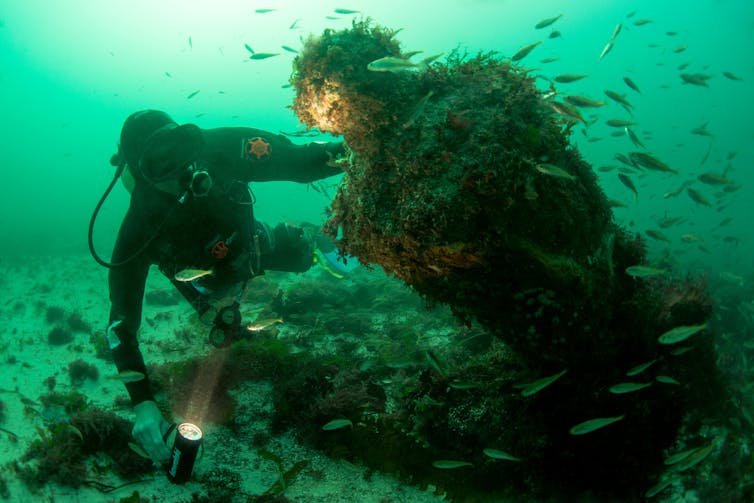
HMS Colossus sank near the Isles of Scilly off the the coast of southwest England in 1798. Today, small fish hang out by its cannons. Nature Picture Library / Alamy
Further west along the southern English coast, some of my favourite wreck dives are around Plymouth Sound in Devon. The HMT Elk and James Eagan Layne, both sunk in the second world war, have become vibrant oases for pollock, wrasse and crustaceans, while soft corals and anemones cloak their steel frames.
The most striking is HMS Scylla, deliberately sunk in 2004 to form an artificial reef but now indistinguishable from a “natural” wreck. Its lobsters, sea slugs and shoals of fish showcase how ecology, conservation and human history can come together beneath the waves.
Further afield, the Thistlegorm – another British merchant ship – in the Red Sea near Egypt’s Sinai Peninsula has become one of the world’s most celebrated dive sites, brimming with snapper, groupers, and even turtles.
Life will quickly colonise a new habitat
Shipwrecks demonstrate the extraordinary capacity of marine life to adapt, turning human detritus into ecological opportunity. Hard structures are valuable in many parts of the ocean, especially where overfishing, coastal development and overheated waters have damaged natural reefs.
[
](https://images.theconversation.com/files/708111/original/file-20251211-62-xawgds.jpg?ixlib=rb-4.1.0&q=45&auto=format&w=1000&fit=clip)
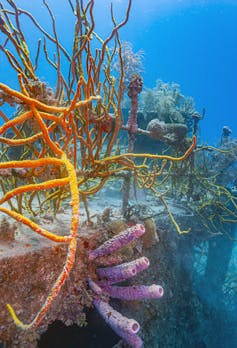
Shipwreck coral in the Caribbean. John A. Anderson / shutterstock
A wreck offers stability and a complex mix of species – two things ocean animals find hard to come by. Over decades, a wreck can support entire food webs, from bacteria to apex predator sharks.
But these ecosystems tell us something else: they are accidental laboratories for understanding how marine species respond to environmental change. Wrecks show how quickly life will colonise and exploit a new habitat, providing lessons for restoration work elsewhere.
A cultural and ecological legacy
For the UK, with its extraordinary maritime history, wrecks also form part of the national story. They are reminders of war, trade and exploration, but also of the sea’s capacity to transform and regenerate. Divers get to experience the wonder of swimming through history as thriving marine life reclaims metal, wood and cargo.
As coral reefs decline worldwide, shipwrecks and artificial reefs will likely grow in importance. They will never replace the coral giants of the tropics, and nor should they be used as an excuse to neglect the protection of existing habitats. But shipwrecks can act as sanctuaries, research sites and beacons of resilience in a changing ocean.
They also invite us to see the sea differently – not as a dumping ground, but as a realm where even loss and ruin can be reshaped into new life. The challenge for humanity is to move from accidents of history to intentional acts of restoration, creating a future where marine ecosystems are given the protections they need to thrive.
 Instagram Engineering
 Shopify Engineering

