Although at first glance potassium-titanite (TISMO) whiskers don’t seem to be much of a change from chopped glass- and carbon fiber in FDM filaments, they’re really quite different. They’re not only much smaller, they’re also less abrasive, and work with 0.2 mm nozzles. Although basically just found in industrial filaments right now, [JanTec Engineering] put a spool to the test to see what these whiskers bring to the party.
While at an event in Japan, [JanTec] got handed a spool of Poticon STD1 NTL34M PA filament, presumably the common PA6, AKA Nylon. In their messaging the company calls it LEXTER, a bio-based polyamide.
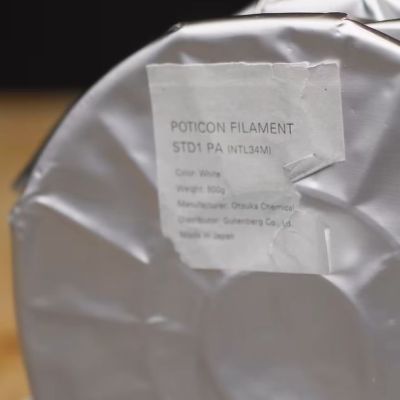
This was subsequently put to the test after returning home, with the recommended print settings and the newly constructed testing machine, called the Atlas 2000. This is an open source testing machine that could be handy if you have about $500 lying around and an urgent need to test the tensile, compression and bending properties of materials.
The filament under test is 20% TISMO by weight, with it scoring well in the tensile strength test, while being about as brittle as the datasheet suggests. Such reinforced polymers are generally known for being stiff and brittle, so this is little surprise. Perhaps the biggest advantage of this filament is that you can print finer details with it using an 0.2 mm nozzle, making it an interesting engineering filament in that respect.
Also touched upon in the video are the potential health risks of this filament, with these whiskers being definitely easy to inhale. This also is reminiscent of the potential carcinogenic risks of chopped carbon fiber, where fragments of these already small fibers can pose similar risks as asbestos.
As for the constant brittleness in these purported reinforced filaments, this would seem to be due to poor adhesion between the fiber (or whisker) and the thermoplastic. Unlike with thermoset polymers where there’s an active interface between the fiber and the polymer that creates a strong molecular bond, there’s generally a void between thermosets and additives like fibers due to the lack of any chemical activity while cooling.
 Instagram Engineering
 Shopify Engineering


