Skip to content
If you wanted to build a clock with a 7-segment display, there are a wide variety of ways you might go about it. You could grab some 74-series logic chips and create a whole bunch of counters and decoders to drive the display, or you could wire up a microcontroller with an RTC and have it do the hard work. Or, as a Japanese company once did… you could create a “digital” looking clock with no digital electronics whatsoever.
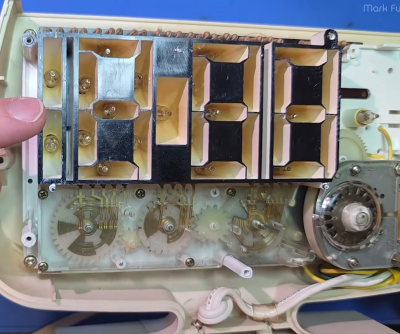
The geared mechanism and switch contacts are visible; they switch the neons of the various segments on and off at the correct times. Credit: YouTube video
[Mark Furneaux] set about tearing down a Lumitime clock, built by the Japanese company Tamura. From the outside, it appears to be a rather stylish digital clock, with a bold red 7-segment display lit with neons. And in some regards, it is. Only, the secret of this clock is that it doesn’t use digital electronics to do the job. There are no counters inside, no real-time clock module, no transistor-based logic chips doing the counting with the output of a 32.768 KHz crystal. Instead, a motor drives a series of gears that turn metal plates that move under sliding finger contacts. The gear train and the metal plates are designed such that the contacts turn the various segment neons on in the correct sequence to display the current time. It’s like a player piano, only instead of playing a tune, it’s switching the segments of a display on and off to display the right numerals at the right time.
It’s a neat way to do a “digital” clock from an era when proper digital electronics were still very expensive. We’ve seen all kinds of whacky 7-segment clocks before, too, like this amusing water-based build. Video after the break.
 Instagram Engineering
 Shopify Engineering


