Skip to content
Odds are, you’ve taken pills before; it’s a statistical certainty that some of you reading this took several this morning. Whenever you do, you’re at the mercy of the manufacturer: you’re trusting that they’ve put in the specific active ingredients in the dosage listed on the package. Alas, given the world we live in, that doesn’t always happen. Double-checking actual concentrations requires expensive lab equipment like gas chromatography. It turns out checking for counterfeit pills is easier than you’d think, thanks to a technique called Disintegration Fingerprinting.
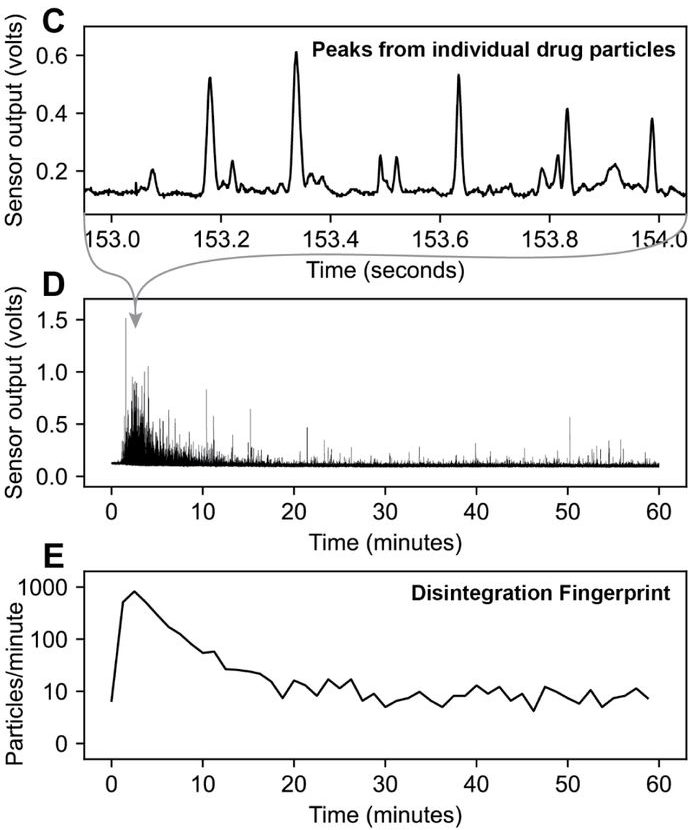
The raw voltage signal from the sensor is stored as a “disintegration fingerprint” of particles detected per minute.
It’s delightfully simple: all you need is a clear plastic cup, a stir plate, and a handful of electronic components — namely, a microcontroller, a servo, and an IR line-following sensor. You’ve probably played with just such a sensor: the cheap ones that are a matched pair of LED and photodetector. It works like this: the plastic cup, filled with water, sits upon the stir plate. To start the device, you turn on the stir plate and actuate the servo to drop the pill in the water. The microcontroller then begins recording the signal from the photo-diode. As the pill breaks up and/or dissolves in the water, the swirling bits are going to reflect light from the IR LED. That reflectance signal over time is the Disintegration Fingerprint (DF), and it’s surprisingly effective at catching fakes according to the authors of the paper linked above. Out of 32 different drug products, the technique worked on 90% of them, and was even able to distinguish between generic and brand-name versions of the same drug.
Of course, you do need a known-good sample to generate a trustworthy fingerprint, and there’s that pesky 10% of products the technique doesn’t work on, but this seems like a great way to add some last-mile QA/QC to the drug distribution chain, particularly in low and middle-income countries where counterfeit drugs are a big problem.
We’ve featured pill-identifiers before, but machine vision is going to be much more easily fooled by counterfeits than this method. If your problem isn’t worrying that your pills are fake, but forgetting to take them, we’ve had projects to help with that, too.
Thanks to [Zorch] for the tip!
 Instagram Engineering
 Shopify Engineering