One of the small advantages of riding in the front seat of a Cuenca taxi, apart from the superior view of traffic misdemeanors and roadside drama, is that the dashboard functions as an unexpectedly reliable indicator of financial evolution. Permits, guardian saints, and, increasingly, a tidy arrangement of QR payment stickers: Deuna, JEP, Jardín Azuayo.
I asked a driver recently what commission he paid on these electronic payments, expecting a familiar complaint about percentages nibbling away at his fares. He replied that the service was free. No charge.
“Free,” being one of those words that benefits from cautious handling, did not mean that no cost existed anywhere in the system, but rather that nothing obvious was being deducted from his end of the transaction as far as he could see. From the driver’s perspective, and that of many small merchants in Cuenca, the arrangement works well enough to feel costless.
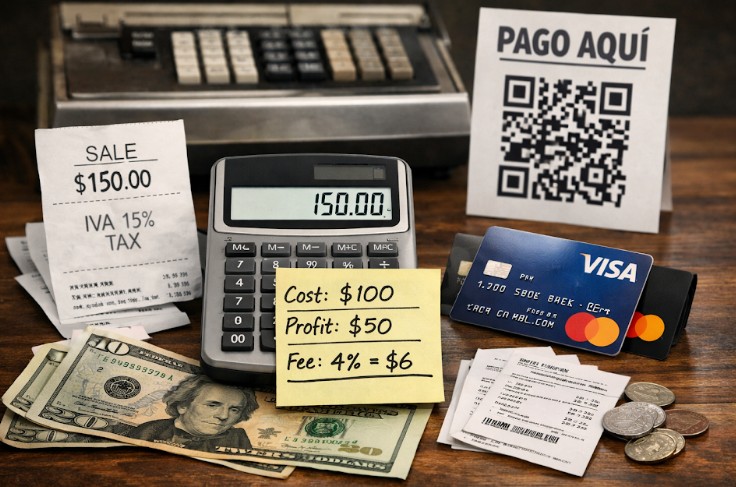 This contrasts rather sharply with the card-dominated economies of the United States and Canada, and these days also the UK, where Visa, Mastercard, and sometimes American Express form the invisible scaffolding of everyday spending. Tap a card, tap a phone, walk away. The experience is undeniably convenient, reassuringly fast, and backed by formidable fraud protections. Yet convenience, like most luxuries, carries a price that is often poorly understood.
Visa and Mastercard remain marvels of global financial engineering, but they are no longer cheap marvels. The steady upward drift of processing costs has become a topic of increasing conversation among merchants who must either absorb the expense or pass it along in ways customers eventually notice.
When merchants complain about “four percent,” customers sometimes imagine this as a minor administrative nuisance absorbed somewhere in the vast machinery of commerce. The mathematics tell a more interesting story.
Consider a simplified example. A merchant purchases an item for $100 and sells it for $150. The gross profit is $50. If the card processing cost is 4 percent of the sale price, the fee amounts to $6. That $6 is not 4 percent of the profit; it is 12 percent of the merchant’s margin. The calculation becomes even less forgiving once sales tax enters the picture. In Ecuador, where 15 percent IVA is included in the price, card fees are applied to the full amount, meaning the merchant pays processing charges not only on their own revenue but also on the portion destined for the tax authorities, thus creating a kind of tax on a tax that is paid by the merchant. In the United Kingdom and other VAT-based economies, where rates may reach 20 percent, the same arithmetic applies, (although the same would apply at a lower level to state sales taxes in the US.)
Margins, particularly in retail and hospitality, are rarely as generous as customers might suppose. A café, a small restaurant, a taxi driver, or a neighbourhood shop may already be juggling rent, wages, utilities, taxes, spoilage, and the perpetual uncertainty of demand on rainy days. Under such conditions, a few percentage points extracted from each transaction cease to be trivial and begin to resemble a tax on survival.
From the consumer’s viewpoint, card payments feel almost magical. There is no visible deduction labelled “interchange,” no helpful annotation explaining that part of the purchase price has been diverted through issuing banks, acquiring banks, processors, and global card networks whose logos convey stability but whose economics are designed, quite reasonably, to generate profits at your expense. This is made even handier for the consumer if they have ApplePay or GooglePay which are really overlays to credit and debit cards.
In Ecuador, by contrast, many digital payments bypass that elaborate international system of tolls or trolls, depending on your point of view. Systems such as Deuna operate largely as account-to-account transfers, typically initiated by scanning a QR code and confirmed within a mobile banking application.
Systems such as Deuna are really an elegant shortcut built upon a familiar foundation. Anyone who has used online banking knows that sending money to another customer at the same bank can be done with relative ease, provided one is prepared to wrestle with account numbers, CI card numbers, emails, and the occasional typo. Deuna reduces this ceremony to a scan of a QR code and a tap of approval, sparing both parties the small anxieties of manual data entry as long as the payer can make sure to avoid paying $350 for an almuerzo instead of $3.50c.
The merchant may pay little or nothing per transaction, the funds usually arrive immediately and no physical terminal is required. A printed receipt is replaced by a glowing screen and, occasionally, a quick photograph on a cell phone taken by staff as a modest audit trail or a way of counting the day’s takings.
The procedures vary. In some establishments, staff simply inspect the confirmation screen presented by the customer, relying on familiarity and experience. In others, they wait for the reassuring chime of a payment notification. To visitors accustomed to rigid card-terminal rituals, this flexibility can appear faintly improvised, yet it reflects rational adaptation to local realities: smaller transaction values, sensitivity to fees, and the practical need to keep service flowing during the almuerzo rush.
What makes these QR-based systems economically intriguing is their structural simplicity. When payer and payee share the same bank, the transaction does not require money to traverse a web of intermediaries and currency exchange rates. The bank merely updates its own records, subtracting from one account and adding to another. A card payment, by comparison, usually engages a considerably more elaborate ecosystem of issuers, acquirers, processors, and network operators, a structure that delivers extraordinary convenience and protection while also explaining why the associated fees are rarely negligible.
Even a customer loyal to a single bank benefits from this arrangement. Local merchants easily maintain multiple accounts across different institutions, enabling them to accept a range of QR payment systems. What appears to be a simple sticker display is, in reality, a sophisticated interoperability strategy conducted at street level.
Brazil offers perhaps the most dramatic illustration of where this model can lead. The Pix system, introduced by the Brazilian central bank, allows instant, low-cost transfers between individuals and businesses using QR codes, phone numbers, or simple identifiers. Adoption has been astonishing. Street vendors, supermarkets, professionals, and taxi drivers accept Pix as casually as cash once was. Card usage did not vanish altogether, but it was forced to compete with a system that is much faster for settlement and frequently cheaper for merchants.
The implications are not merely technical. Payment systems shape pricing, margins, consumer behaviour, and ultimately the distribution of profit across the economy. When fees rise, merchants adjust. Prices creep upward, minimum card spends appear, discounts for cash re-emerge, or profitability narrows to the point where resilience suffers.
None of this renders Visa or Mastercard villainous. They provide extraordinary global interoperability, sophisticated fraud management, and consumer protections that few domestic systems can fully replicate. Their services are valuable, but discomfort arises when the cost of that value becomes large enough to be felt by those operating closest to the margin: small merchants, independent operators, and service providers whose businesses are built on modest sums repeated many times a day.
And so the Cuenca taxi driver’s dashboard, adorned with QR stickers rather than a humming card terminal, becomes a small but telling symbol of an alternative equilibrium — one in which payment remains digital yet some of the toll booths are bypassed, the hardware is just a phone, and the transaction itself recorded and anchored in a shared acknowledgement that the numbers on a screen have aligned as intended. And the passenger, as long as they have a live data connection, simultaneously ensures that they don’t have to dig coinage out of a back pocket or pick up quarters from the gutter, and that they have not mislaid their precious phone in the taxi.
 Instagram Engineering
 Shopify Engineering