LONDON A-Z
F is for Farnborough
For my next alphabetical visit to unsung suburbs we're off to Farnborough, not the Hampshire town with the air show but the former Kent village on the outskirts of Orpington. What a lovely place to live; convincingly rural, urban-adjacent and suitably bypassed.

Farnborough has Norman roots and grew up astride a ridge on the main road from London to Sevenoaks. A bit further on than Locksbottom and not quite as far as Green Street Green, if that helps you locate it. The name means 'village among the ferns on the hill', or did when that name was originally Fearnbiorginga. For many years it boasted several coaching inns, then on 13th April 1927 a bypass was opened for which current residents are extremely grateful, publicans excepted. It's now a quaint linear village on the brink of the North Downs, but with a wedge of suburban infill on the bypassed flank which helps sustain a busy community, so essentially the best of both worlds. If you've ever walked London Loop section 3 you'll have seen this for yourself.

In the middle of the village is a triangular space faced by rows of cottages and a mortgage broker. The central greenspace has all the obligatory parochial features - a village sign, a flagpole, some benches around the base of a tree and one of those flat silhouettes of a WW1 soldier with his rifle planted in the ground. A small flowerbed has been immaculately planted with bright bedding plants, all of which looks uplifting until you spot that the sponsor is the local mausoleum, or as the business-speak puts it "the UK's first indoor above-ground burial facility". Renting a niche for your loved one starts at £40 a month, rising to £93,555 for a 99 year lease on a family vault.

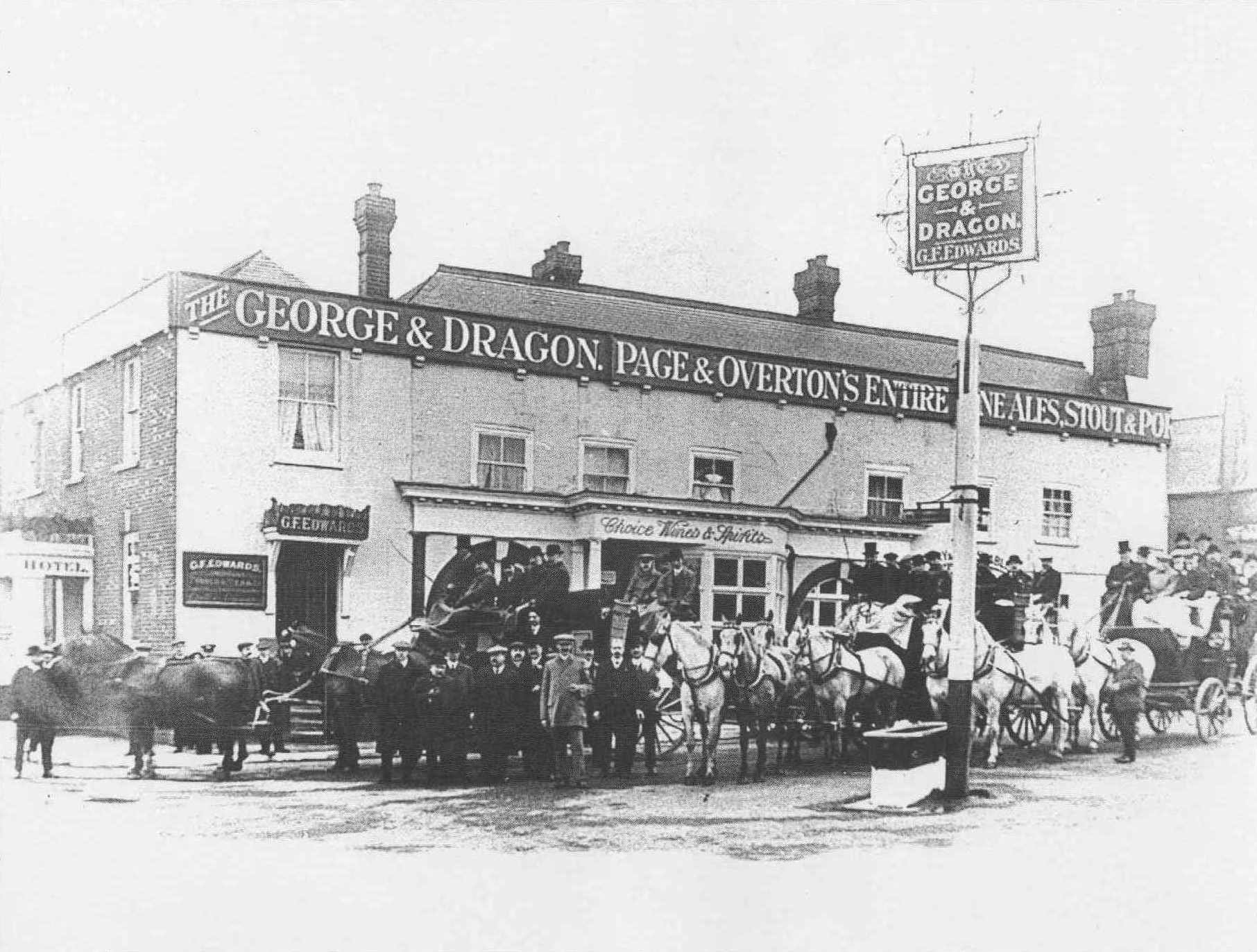
Villagers have been particularly good at placing informative plaques beside points of interest, for example outside old inns and alongside the village pump. That's a nice old pump I thought, then I read more carefully and learned it's not the original (they bought it at auction) nor is it on the original site, instead positioned on some incongruous grass where the village pond used to be. Another plaque, nudged into a picket fence, points out the prominent site of an 18th century coaching inn called The George. After the bypass was built it became a pub called The George and Dragon, then in the 1970s merely a restaurant and more recently a small millennial housing development. It's a little odd to be looking at a black and white photo of bowler-hatted passengers in horse-drawn coaches while in front of you a window cleaner is up a ladder using his squeegee on replacement uPVC windows.

Two former coaching inns survive - The Woodman and the Change of Horses (formerly known as the New Inn). Coach drivers would stay here overnight, their horses put out to pasture in the field opposite, while passengers were instead accommodated in greater comfort at The Whyte Lion up the road in Locksbottom. Today both Farnborough pubs lure in their punters with
Craft Beers and Home Cooked Food, and in one case Dog Friendly Quiz Nights (although on closer inspection that's probably two attractions). I note that The Woodman's somewhat unadventurous menu tops out at £15 for 'Trio of sausages' whereas the Change of Horses' longlist stretches to £21 for 'Ultimate Pie of the Day', so I'd suggest your palate would probably prefer the latter.

The shops are decent, along a parade that's patently been extended as the size of the village has grown. The only chain in sight is Londis where the Post Office still resides, while elsewhere you can get your bike fixed, your nails done and some brunch cooked. The village barber is called Ieuan and the village delicatessen is run by Nanny Smith, although I suspect that may be a pseudonym. Birds Tea Rooms are sadly long gone, this the preferred refreshment opportunity for the weekend crowds that started flocking from London after the number 47 bus was extended to terminate here in 1913. As for the former bank, seemingly much too large for such a small village, it's been cleverly repurposed as the local doctors' surgery. The blacksmith's cottage nextdoor is creepily overdecorated, this because it's been converted into what looks like an exuberantly twee antiques shop.

10 Farnborough nuggets
• Farnborough's main road is one of London's 57 High Streets.
• The village green alas got turned into a road junction, it's where the bypass bears off.
• A milestone near The Woodman confirms 'London 14 Sevenoaks 10'.
• This being ex-Kent yes, there is a converted oast house.
• I spotted a private cul-de-sac called Strawberry Fields, but no Penny Lane.
• Farnborough Old Boys Guild FC lost five nil to Otford on Saturday.
• The village hall hosts Karate, am-dram, bridge, pilates and two W.I.s.
• The cottage with the tiny front door on Church Street is called Little Door Cottage.
• It's a 25 minute walk to Orpington station up Tubbenden Lane.
• Wikipedia says Nigel Farage was born in Farnborough, but that may just be because Princess Royal University Hospital in Locksbottom is technically in Farnborough parish.

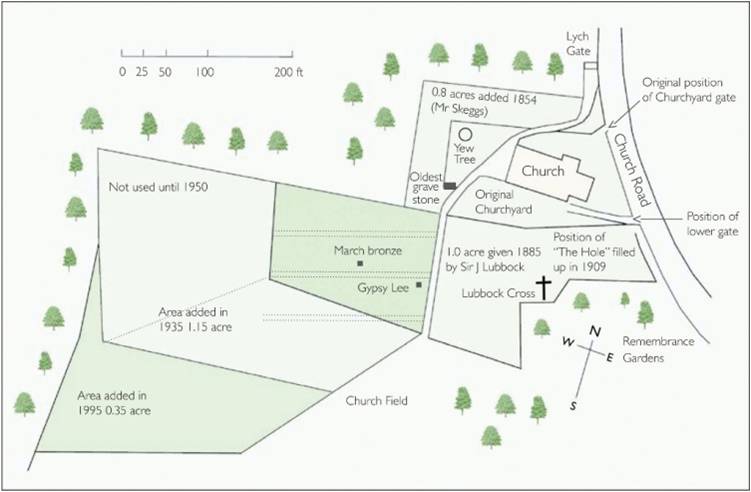
For the best part of Farnborough you have to head south down Church Road, this leading unsurprisingly towards the church of St Giles The Abbot. It's impressively old and flinty, the main portion of the nave dating back almost 900 years, and topped by a typically squat Kentish spire. Even if you have to make do with the exterior it's pretty impressive, including a large graveyard, the village war memorial and a seriously chunky yew tree planted in 1643 after a particularly ferocious storm. The grave to hunt for is that of Urania Boswell, better known as ‘Gipsy Lee’, whose ostentatious Romany funeral procession in 1933 was memorably captured by Pathé News.

Below the church the land opens up and drops away into open countryside, a boon for every local dogwalker, or you can thread down through a strip of woodland instead. At the foot of the slope you enter High Elms, now a 250 acre country park but originally the country seat of the Lubbock dynasty. The 4th Baronet, John Lubbock, was one of the more consequential Victorian politicians. It was he who introduced the Bank Holidays Act to Parliament in 1871, also the Ancient Monuments Act in 1882 which preserved Stonehenge and Avebury, also he who coined the words coined the terms "Palaeolithic" and "Neolithic", also a founder member of the Electoral Reform Society, also Chairman of the London County Council, also President of the Royal Statistical Society, also a childhood friend of Charles Darwin who lived a short distance away at Down House. Not bad for a posh boy from Farnborough.

Today you can wander freely round his estate, other than the chunk that's become a golf course, exploring chalk slopes, ornamental gardens and deep woodland. Alas the big mansion burnt down in 1967 and the site is now a flat lawn surrounded by all the original terraces and shrubbery so quite an eerie prospect, not least the drive that sweeps up to a crescent of tiles laid outside the kitchen door. Closer to the car park Bromley council maintain an outdoor education centre complete with beehives, dipping pond and nature trail, although you have to come at the weekend to pick up local maps and trail leaflets. The cafe was proving very popular, even midweek, although I'm not sure the ladies who lunched really wanted the wild boar burger in a brioche bun at the top of the specials board.
It seems extraordinary that this is part of our capital city, but that's F in London for you.
 Instagram Engineering
 Shopify Engineering